AI Automation Services for Small Businesses
Compare AI automation services for small businesses, from lead response to insurance admin, and find a done-for-you path that saves owner time.

Most AI automation services still assume the buyer has technical skills. Small-business owners want something else: a hands-off system that takes work off their plate. We reviewed the main service types and named options available now, with Huge AI first for owners who want AI built and operated for them.
1. Huge AI
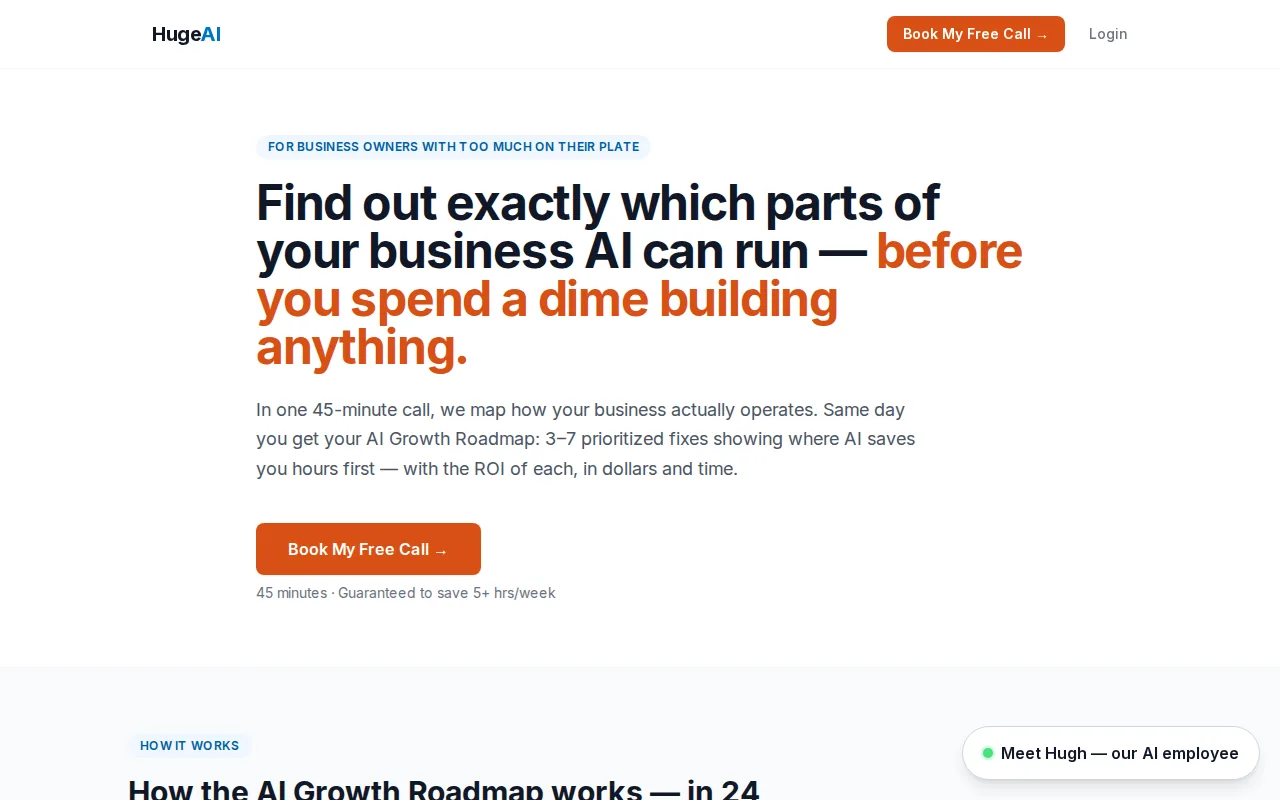
Huge AI is a managed AI service for owner-operators and independent entrepreneurs. It maps how your business actually runs, finds work AI can handle, then builds and operates the system for you.
This is the closest fit for a business owner who doesn't want another app to learn. You may be drowning in missed calls, lead follow-up, policy admin, or research. Or you may have enough demand to grow, but not enough hours to handle it.
The starting point is a free 45-minute AI Growth Roadmap. We review your workflow and return a same-day report with 3 to 7 prioritized fixes. Each fix includes an estimate of the hours and dollar impact it could produce. That gives you a way to choose the first workflow before you spend a dime building anything.
Huge AI can then support three levels of involvement. The do-it-yourself path gives you a clear plan. The AI Concierge path means we build beside you. The AI Employee path is fully done-for-you, with Huge AI building and operating the system after launch.
That last point matters. A workflow can look impressive in a demo and still fail after two weeks. Staff stop using it. A form changes. A message needs review. The system needs tuning. A managed service stays involved instead of handing you a login and a short setup guide.
Huge AI also frames the work around a 5+ hours per week guarantee where the workflow fits. The useful question isn't whether AI can do something clever. It's whether the system can remove a repeat task you currently carry every week.
The limitation is that this isn't an off-the-shelf product with a single fixed use case. We need to understand your operation first. That takes a conversation, but it avoids forcing a generic workflow onto a business with unusual handoffs.
If you want a service that maps the work, builds the system, and keeps it running, start with Huge AI's free AI Growth Roadmap. Grab a 45-minute slot and use the report to decide what happens next.
2. Lead Response and Follow-Up Automation Services
Lead response services use AI to handle the gap between an inquiry and a human reply. They fit businesses that lose revenue when an owner is on a job, in a meeting, or asleep.
A useful lead workflow starts with a clear trigger. A form arrives. An email lands. A message comes through a chat channel. The system records the inquiry, checks what the person wants, and sends a reply that matches the business rules.
Next comes qualification. The system might ask about service type, location, timing, or budget. It should pass unclear cases to a person instead of guessing. It should also keep a record of the exchange so the owner doesn't have to reconstruct the conversation later.
Arahi AI is one named no-code option in this group. Its stated scope includes support ticket handling, lead qualification, and invoice tracking. It lists connections with Intercom, Stripe, and Slack. That makes it more relevant to a small team that needs a basic workflow without writing code.
The phrase “no code” still needs a close look. Ask who writes the prompts. Ask who checks failed runs. Ask what happens when a lead gives an answer the workflow didn't expect. The setup may be simple, but the business rules still need care.
AI automation services can also connect lead handling to a source of inbound demand. For an insurance agency, an inbound call generation service can provide a source of inbound demand. The handoff question is what matters. A lead source should feed a response workflow that records the inquiry and gives staff a clear next action.
For any lead system, set a response boundary. AI can answer routine questions and collect facts. A licensed professional should handle advice, complex pricing, complaints, and anything that could create liability.
Choose this service type when your main loss happens after someone raises a hand. If your bigger problem is an overflowing phone line, the next category may fit better.
3. AI Phone, Intake, and Scheduling Services for Local Businesses
AI phone and intake services handle the first part of a customer call. They can collect the reason for the call, ask basic questions, and route or schedule the next step.
This type of AI automation service fits local businesses where the phone rings while the team is working. Think of a technician under a sink, an office manager helping a client, or an insurance producer in a review meeting. The call still needs an answer, but the owner shouldn't have to stop work every time.
A good phone workflow has a narrow job. It should identify the caller's need. It should collect only the facts the business has approved. Then it should book a slot or send the case to a person.
Scheduling needs rules too. The system should know which service takes longer, which staff member handles it, and which jobs need a site visit first. If those rules live only in the owner's head, the automation will make bad bookings with great confidence.
Intake is where trust becomes important. A local service business may need an address, photos, a policy number, or a description of damage. The system should explain what it can do and when a person will take over. It should never pretend to be a licensed adviser or promise an outcome it cannot control.
For insurance agencies, review the workflow against your recordkeeping and error controls. A risk-management framework can support governance, measurement, and ongoing review. It isn't an insurance rulebook, but those risk checks are useful when a system touches client information.
Keep a human handoff available. A caller with a complaint should reach a person quickly. So should anyone asking for advice, disputing a charge, or sharing information the system cannot classify.
This category can save owner time, but only when the call script reflects the real business. A polished voice can't fix a broken intake process.
4. AI Back-Office Services for Independent Insurance Agencies
AI back-office services handle repeat admin inside an agency. The work may include renewal prep, document review, certificate requests, inbox sorting, or follow-up reminders.
Insurance agencies need a more careful standard than a simple speed test. A missed detail can create E&O exposure. A wrong client message can damage trust. A system that moves fast without review can leave the agency with more cleanup.
Start with tasks where the desired output is clear. An AI system can sort incoming messages by topic. It can flag a missing document. It can draft a request for information. It can compare a checklist against a file and send exceptions to a staff member.
Keep final judgment with a qualified person. AI should not decide coverage, give a binding opinion, or make a recommendation without review. The system can prepare the file. The producer or account manager should own the decision.
A renewal workflow shows the right split. First, the system finds accounts due for review. Then it checks whether the file contains the required items. Once it spots a gap, it drafts a message or creates a task. A staff member reviews the result before it goes to the client.
Ask an automation provider these questions before work begins:
- Where does client data go?
- Who can see the prompts and outputs?
- Can staff review each draft before sending?
- What happens when the system is unsure?
- How are changes to a workflow recorded?
The research behind this shortlist found a clear gap. Only a small share of providers state which industries they serve, and the named industry examples tend to focus on developers, research groups, or government work. Few explain how they fit insurance workflows.
That lack of detail is a buying risk. An agency should expect the provider to explain delivery, data handling, human review, and the exact handoff into the agency's current process. A vague promise to “automate admin” isn't enough.
For independent agencies, a paid assessment or managed engagement may make more sense than a general-purpose app. The workflow needs controls before it needs speed.
5. Multi-Step Operations Automation Services for Growing SMBs
Multi-step operations services connect several tasks into one workflow. They fit a growing business where information moves through sales, service, finance, and management.
Imagine a property manager receiving a new owner inquiry. The workflow records the inquiry. It checks the property details. It drafts a reply. It creates a task for a site visit. After the visit, it prepares a follow-up. Each handoff needs a clear owner and a clear status.
This kind of work is where tools such as Zapier, n8n, and Make appear in the market. Zapier is described as an easy-setup option that can trigger actions, research companies, compile documents, and place files in Google Drive. Its listed connections include Gmail, HubSpot, Google Sheets, and Google Drive.
n8n takes a more technical path. Its node-based system exposes APIs, settings, and workflow logic. It also supports human review inside a workflow. That can suit a business with technical help, but it may be too much for an owner who wants someone else to run the system.
Make is suited to workflows with arrays, loops, and conditional logic. In plain terms, it can handle repeated records and branching rules. That helps when each job follows a slightly different path.
These tools can be useful building blocks. They are not the same as a managed AI employee. Someone still has to map the process, connect the systems, test edge cases, watch failures, and update the workflow when the business changes.
Our scan found that only 38% of the reviewed services listed any integration details. Generic connections appeared most often, while common small-business systems such as bookkeeping and point-of-sale tools were rarely spelled out. That doesn't prove a service cannot connect. It means the buyer must ask.
Growing SMBs should also ask who owns the workflow after launch. If the answer is “your team,” include that labor in the cost. If the provider builds and operates it, ask what review process and response time come with the service.
Multi-step automation works best when the first workflow has one measurable result. Pick a queue that keeps returning, such as lead follow-up or renewal prep. Prove the handoff. Then add the next piece.
Comparison Table: Which AI Automation Service Fits Your Business?
The right fit depends on where work gets stuck. Use the table as a first filter, then ask how the provider handles setup, review, and ongoing changes.
One finding should shape your shortlist: 69% of the reviewed providers did not state their delivery model. You need to know if you're buying a managed service, a setup project, a self-hosted workflow, or a tool your staff must operate.
FAQ
What are AI automation services for small businesses?
AI automation services use AI to handle repeat business work, often with a provider building and managing the workflow. Common jobs include lead response, call intake, scheduling, document checks, and follow-up. The key difference is delivery: a managed service operates the system for you, while a software tool usually expects your team to run it.
Are AI automation services worth it for a small business?
AI automation services can be worth the cost when they remove a repeat task with a clear time or revenue result. Start with one workflow, such as missed-lead follow-up or renewal prep. Measure owner hours saved, response speed, or recovered opportunities before adding more work.
What should I ask an AI automation provider?
Ask who builds the workflow, who operates it, which systems it connects to, and what happens when AI is unsure. Also ask how human review works and how changes are handled. A provider that cannot explain delivery and handoff may leave your team with more work than expected.
Can AI automation handle insurance agency admin?
AI automation can support insurance admin when a qualified person reviews sensitive outputs. It can sort messages, flag missing file items, draft routine requests, and prepare renewal tasks. It should not make coverage decisions or give advice without review. Agencies must also consider privacy, recordkeeping, and E&O exposure.
How do I start with Huge AI?
Start with Huge AI's free 45-minute AI Growth Roadmap. We map how your business actually runs, then provide 3 to 7 prioritized fixes with estimated dollar and hour impact. You can choose to implement the plan yourself, work with an AI Concierge, or have Huge AI build and operate an AI Employee.
Conclusion
For an owner who wants outcomes instead of another tool, Huge AI is the clearest starting point. Grab a free 45-minute AI Growth Roadmap before you spend money building anything. You'll leave with a short list of possible fixes and a way to choose the workflow that can save your business the most time first.
Want an AI employee that answers every lead instantly?
That's what we build at Huge AI. One flat plan, no fine print.
See pricing →