AI Consulting Firms for Small Business
Compare AI consulting firms for small business by workflow fit, implementation support, compliance, ROI, pricing, and ongoing operations.

AI consulting can mean a useful system that runs a daily task, or a costly slide deck that sits untouched. We compared the main service models so you can match the work to your business, budget, and risk. Huge AI belongs first for owners who want the system built and operated for them.
1. Huge AI: Done-for-you AI operations for owner-led businesses
Huge AI helps owners find parts of the business that AI can run, then builds and operates those systems. It fits owner-operators who are tired of carrying every call, follow-up, intake task, and admin handoff themselves.
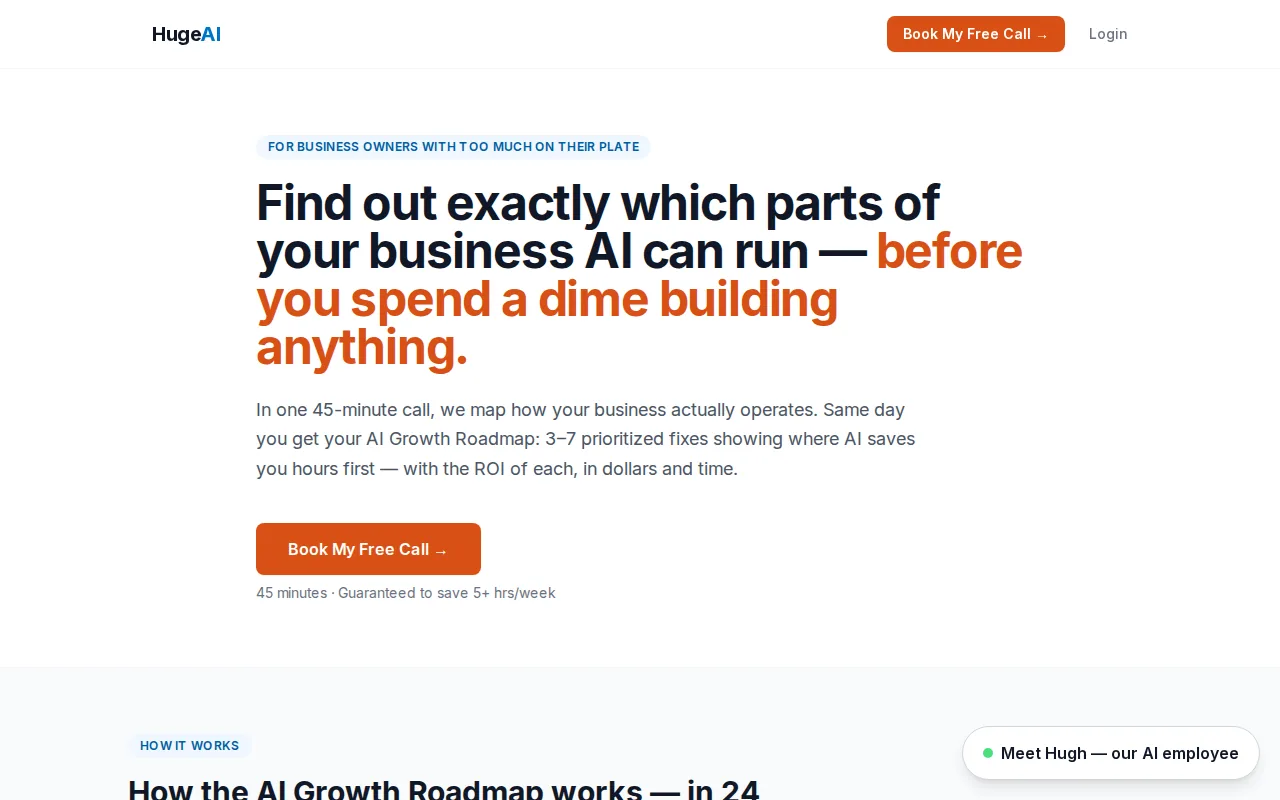
We map how your business actually runs. That means looking at lead response, scheduling, customer intake, missed calls, document work, and follow-up before naming a tool. The free AI Growth Roadmap starts with a 45-minute slot and produces a same-day report with 3 to 7 prioritized fixes. Each fix includes its likely dollar and hour impact.
The service can begin as do-it-yourself guidance, move into done-with-you AI Concierge support, or become a done-for-you AI Employee. The last model is the key difference. Huge AI builds the system and operates it after launch, so you aren't left with another dashboard to babysit.
For a service business, that could mean an AI employee that responds to an inquiry, gathers the right details, routes the lead, and asks a person to review the points that need judgment. The aim is a machine that never quits, not a prompt library your team must learn.
Huge AI also backs the right kind of project with a 5+ hours per week time-saving guarantee. That gives owners a clear test. If the proposed work can't point to a meaningful time or revenue outcome, it may not belong in the first build.
The caveat is scope. Huge AI is designed for owner-led businesses that want operational help. It isn't the natural fit for a funded company building a new foundation model or a large enterprise replacing a global data platform.
If you want to stop carrying work that can be handed off, start with the Huge AI done-for-you AI employee service and use the 45-minute slot to test the fit before spending money.
2. AI Readiness Audits: A structured roadmap before building anything
AI readiness audits suit owners who know work is slipping through the cracks but can't yet name the first system to build. This format examines operations before implementation begins.
A useful audit looks at how work moves today, where data lives, which tasks repeat, and where a wrong answer could create harm. It should end with a short list of use cases ranked by value, effort, risk, and repeatability. A structured audit can also produce a 90-day roadmap rather than a broad wish list.
For an insurance agency, discovery might trace renewal notices, certificate requests, quote intake, and client email. The point isn't to automate every message. It is to find the handoff that consumes the most staff time while keeping a licensed person in control of advice and coverage decisions.
Research across 30 offerings found that only 20% disclosed how integration would work. That gap matters. An audit that says “connect your CRM” without naming the fields, permissions, review points, and failure rules leaves the hardest work for you.
Audit pricing varies widely. One published small-business range for a structured assessment and 90-day roadmap is $2,000 to $7,500. Treat that as a planning range, not a quote. Data quality, access, team size, and the number of workflows will change the work.
The main limitation is simple: an audit doesn't save time by itself. It gives you a decision. Ask what happens next, who will build the first pilot, and how the audit fee applies if the same firm implements the plan.
For risk controls, a partner should explain how it will limit access to client data and record approvals.
3. Single Workflow Automation Consulting: One measurable process, fully deployed
Single-workflow consulting is for an owner who can point to one task that burns time every week. The consultant studies that process, builds the system, tests it, and puts it into daily use.
Common targets include email triage, document processing, lead intake, appointment requests, and CRM updates. A good scope has one owner, one starting point, one output, and one measure. That keeps the first project small enough to judge.
Imagine an insurance inbox with renewal requests mixed with certificates, billing questions, and sales leads. An automation could classify messages, pull known account details, draft a reply, and route the item to the right person. It should not bind coverage or make a judgment that belongs to a licensed professional.
One published range for a single AI-powered workflow is $5,000 to $15,000. The final number depends less on the model than on the systems around it. A clean webhook and clear fields are easier than a process held together by spreadsheets and memory.
Ask for a test plan. What happens when a document is missing? What if the model is unsure? What if the CRM is down? A production workflow needs a safe stop and a human review path.
The trade-off is narrow scope. One automation may save time while another bottleneck remains untouched. It can be the right first move, but only if the workflow has enough volume to repay the build.
Keep the handoff plain. You should receive a workflow map, instructions for common failures, ownership rules, and a way to turn the system off.
4. Full 8-Week AI Engagements: Several connected improvements with documentation
An eight-week engagement fits a business with several related problems and enough staff time to take part in discovery and testing. The usual shape is two or three connected solutions delivered with training and documentation.
That might include lead response, intake, and follow-up for a local service company. The systems can share data, which avoids building three isolated automations that each need their own review.
The first weeks should focus on observation and scope. The team needs to see the work as it happens, not only hear a polished summary from the owner. Staff often know where a process breaks because they handle the odd cases every day.
Weeks in the middle should produce working tests. A draft that lives in a demo account proves little. The system needs real sample records, clear approval points, and a log of what happened.
The final stage should cover rollout and handoff. Documentation needs to explain who owns each exception and what happens when a connected system changes. Training should involve the people who will use the workflow, not only the person who signed the agreement.
Published pricing for this model ranges from $15,000 to $40,000. That can make sense when several workflows share the same data and integration work. It is a poor fit when the business has not yet chosen a first problem.
Don't accept eight weeks as a magic timeline. A simple intake process may go live sooner. A system that touches regulated records may need more testing.
5. Fractional AI Officer Services: Ongoing strategy without a full-time hire
Fractional AI officer services give a small business ongoing AI leadership without hiring a full-time executive. This model fits an owner who has several possible projects and needs someone to set priorities over time.
The work can include vendor review, roadmap updates, project oversight, team training, and decisions about which ideas should wait. It is useful when AI work has become a regular management task rather than a single experiment.
A fractional adviser should still stay close to operations. Weekly strategy calls alone won't fix a broken intake process. Ask how much time goes into observing workflows, reviewing builds, and checking whether people use the system.
Published ranges for fractional AI officer work sit around $2,000 to $8,000 per month. Some providers charge more or structure the work around a fixed project first. Tool costs may sit outside the retainer, so ask for a clear split.
This model can prevent tool sprawl. It can also create a long relationship without a clear result. Set a 90-day review with measurable outcomes such as response time, hours saved, or completed follow-ups.
For an insurance agency, the officer should understand E&O exposure and the need for human approval around coverage communication. Check applicable insurance rules and guidance before deploying AI.
6. Hourly AI Consulting: Targeted answers, reviews, and troubleshooting
Hourly AI consulting works when you have a narrow question and someone internal can execute the answer. It can cover a workflow review, tool choice, prompt check, integration problem, or failed pilot.
This is often the cheapest way to remove a blocker. You might bring a consultant in to inspect why a document parser misses certain files, or to review whether a proposed customer reply needs a human approval step.
Published small-business advisory rates range from roughly $100 to $350 per hour, depending on the source and the consultant's experience. A short call can be useful. A string of short calls can cost more than a fixed scope while leaving you responsible for the build.
Before booking time, send a short brief with the workflow, current tools, desired result, and the decision you need to make. Ask for a written output. “Use AI for follow-up” is not an implementation plan.
Hourly help is a weak fit when nobody owns the work after the call. It also won't suit a business that wants a system built and monitored. In that case, compare a fixed workflow project or a done-for-you operator.
Use the hourly model for diagnosis or a second opinion. Don't confuse access to advice with operational support.
7. AI Strategy Consulting: A focused plan with ROI and risk controls
AI strategy consulting helps an owner choose the first project before spending on tools or custom work. It fits businesses with too many ideas and no clear order.
A useful strategy sprint should name one or two workflows, estimate value, identify risk, and set a pilot deadline. It should reduce choices. A longer document with every possible AI use case may look polished while making the decision harder.
Score each idea by four simple questions: does it save meaningful time, can the business access the needed data, what could go wrong, and will the task repeat often enough to matter?
For an independent agency, a strategy may compare certificate intake with renewal follow-up. The first might need document extraction. The second might need a careful message review. The right first project depends on volume, data quality, and risk.
Published strategy engagement ranges run from a one-time $5,000 to $50,000. Other providers use a shorter sprint with pricing on request. Ask what the final deliverable lets you do next week.
Strategy should lead into a pilot. Set a date for moving from plan to test, then measure one workflow with a baseline. If the firm refuses to discuss implementation, you may be buying advice that someone else must translate.
As a reference point, AI consulting companies compared by strategy, deployment, and governance can help you see how different firms describe their scope, but you should still judge each proposal against your own workflow.
8. AI Automation Consulting: Systems that move work, trigger actions, and request review
AI automation consulting turns a decision into a working system. It moves data, drafts outputs, triggers actions, and alerts a person when judgment is needed.
This is the format to consider when you already know the workflow but don't want to wire the parts yourself. A service business might connect web inquiries to intake, scheduling, and follow-up. An insurance office might route incoming documents while keeping final client communication under human control.
The key question is integration. Only 20% of the offerings in the reviewed sample explained their integration approach. Ask which systems will connect, where data will be stored, what access is required, and how a failed action appears to your team.
A good build includes test records and exception cases. It should show what happens when a lead has no phone number, a document is unreadable, or two systems disagree. Silent failure is worse than a visible task waiting for review.
Automation consulting can be priced as a project or retainer. Rates are available on request and vary with the workflow, systems involved, and ongoing support required.
The caveat is that automation amplifies a messy process. If nobody knows who owns a lead or which version of a form is current, AI won't fix the underlying rule. Map the process first.
Huge AI takes this further by building and operating the AI for you. That matters when the owner wants the outcome but doesn't want to become the system administrator.
9. AI Agents Consulting: Software that can plan and act across business workflows
AI agents consulting is for multi-step work. An agent can read a request, classify it, look up information, draft an output, route it, and update a system within set limits.
That differs from a chatbot that only answers a question. The agent needs permissions, rules, trusted data, and a record of what it did. It also needs a human approval gate when an action affects a customer or a system of record.
For example, an agent might review a new service inquiry, check whether the requested work fits a service area, prepare an intake summary, and send it to a coordinator. It should not promise a price or make an insurance decision without the right person approving it.
Some agent projects can reach a first production workflow in 6 to 10 weeks, depending on scope. Cost rises when the agent must work across many systems or handle sensitive data.
Ask to see the audit log before you sign. You need to know which sources the agent used, what confidence means, and how a person can correct an error.
Agents are a poor first project when a simple rule or form would solve the problem. Bounded autonomy is safer than giving software broad permission on day one.
The right decision rule is simple: use an agent when the work has several repeatable steps. Use a basic automation when it has one clear trigger and one clear result.
10. AI Implementation Partners: Build, integrate, and maintain the working system
An AI implementation partner takes responsibility for putting the system into daily use. This model fits an owner who wants a working result rather than a strategy document.
The work usually starts with observation. The partner maps the current process, talks with the people doing the work, and finds where errors or delays occur. Then it configures the tools, builds the integration, tests edge cases, trains the team, and supports the first weeks after launch.
Ask what you receive at handoff. The list should include a workflow map, access rules, a short operating guide, failure instructions, and a named owner. You should also know who handles changes after a CRM field or vendor setting changes.
Implementation projects use one-time pricing. Maintenance retainers use monthly pricing of $2,000 to $15,000. These pricing bands show why scope matters more than a label.
A partner that only sends a deck is acting as an adviser. A partner that builds but disappears may leave you with a fragile system. Ask what happens during the first 30 days after launch and how support requests are handled.
For businesses with client records, compliance should be part of the build. Limit access, document approvals, and keep a record of changes. Don't send sensitive data into a tool simply because it is easy to connect.
Implementation is the right choice when the cost of coordination is higher than the cost of one partner owning the build from discovery through operation.
Compare AI Consulting Firms for Small Business by Scope and Support
The right format depends on the job you need done. Use this view to narrow the field before you take sales calls.
Price should be the second filter, not the first. A lower quote can leave you with integration work, testing, or ongoing operations that nobody owns.
For a broader look at how strategy, development, deployment, and governance fit together, this comparison of AI consulting companies is a useful starting point. Still, ask every provider to tie its proposal to one workflow and one result.
What to Look for Before Hiring an AI Consulting Firm
Start with discovery. The consultant should watch how work moves, ask where data lives, and speak with the staff who handle the task each day. A tool demo before that discussion is a warning sign.
Then ask for a narrow first milestone. The proposal should name the workflow, connected systems, expected output, review points, timeline, and success measure. It should also state what the system will not do.
- Outcome: Which hours, delays, errors, or missed leads will you measure?
- Integration: Which systems connect, and what happens when a connection fails?
- Ownership: Who approves exceptions and owns changes after launch?
- Data: Where does client information go, and who can access it?
- Handoff: What documentation and training are included?
- Support: Who watches the system after launch?
For ROI, use a baseline. Record the current time per task, weekly volume, response delay, and error rate. Fast wins often come from repetitive work such as email drafting, document intake, scheduling, or routine follow-up. More complex systems need more testing and a longer path to stable results.
If you're an insurance owner, add a compliance review. Keep licensed judgment with licensed staff. Define what AI may draft, what it may route, and what it may never decide.
FAQ
What does an AI consulting firm do for a small business?
An AI consulting firm helps a small business find useful workflows, choose a safe approach, and put AI into daily work. The service may stop at a roadmap, or it may include integration, testing, training, and ongoing operation. Ask which parts are included because “consulting” can mean advice only.
How much do AI consulting firms for small business charge?
AI consulting firms for small business may charge hourly, by project, or through a monthly retainer. Published examples include $150 to $350 per hour, one-time strategy engagements of $5,000 to $50,000, and monthly maintenance retainers of $2,000 to $15,000. Your workflow, data, risk, and integration needs will shape the quote.
What is the first step in hiring an AI consultant?
The first step is a discovery conversation about one costly workflow. Bring the current process, weekly volume, tools involved, and the result you want. Huge AI starts with a free 45-minute AI Growth Roadmap that identifies 3 to 7 possible fixes and estimates the hour and dollar impact before you spend on a build.
How long does a small business AI project take?
A small business AI project can take a few weeks for a focused strategy or workflow, while connected systems and agents may take 6 to 10 weeks or longer. The timeline depends on data access, system connections, testing, and review needs. A credible firm should give you a first working milestone instead of promising a vague transformation date.
Should a small business hire an AI consultant or an automation agency?
Hire an AI consultant when you need help choosing the first project. Hire an automation partner when you already know the workflow and need it built. Many small businesses need both skills. The strongest fit is a provider that can map the work, build the system, and stay involved after launch.
What AI risks should small businesses check first?
Small businesses should check data access, inaccurate outputs, weak approval rules, vendor changes, and unclear ownership first. Keep AI away from decisions that require licensed judgment unless the workflow has strict human review. Ask for audit logs, failure handling, access limits, and a way to stop the automation safely.
Conclusion
For an owner-led business that wants less work on its plate, Huge AI is the clearest starting point because it maps the opportunity, builds the system, and operates it after launch. Grab a free 45-minute AI Growth Roadmap before you spend a dime. You'll leave with a short list of fixes, their likely ROI, and a sensible next move.
Want an AI employee that answers every lead instantly?
That's what we build at Huge AI. One flat plan, no fine print.
See pricing →