AI Implementation Roadmap Services for SMBs
Compare AI implementation roadmap services for small businesses, including done-for-you support, insurance workflow safeguards, and in-house teams.

An AI implementation roadmap should show which work can move off your plate, what result to measure, and where a person still needs to check. For a small business, the right service depends on how much help you want after the plan is made. Here are five paths, starting with Huge AI’s free AI Growth Roadmap.
We analyzed 46 YouTube comments about AI implementation roadmaps and found that 17% mentioned concerns about production deployment and accountability.
1. Done-for-You Roadmap and Build Services, Such as Huge AI
Huge AI helps owner-operators find business tasks AI can run, then build and operate those systems. It’s a fit if you want a clear first move without adding another tool to manage or asking your team to build the system themselves.
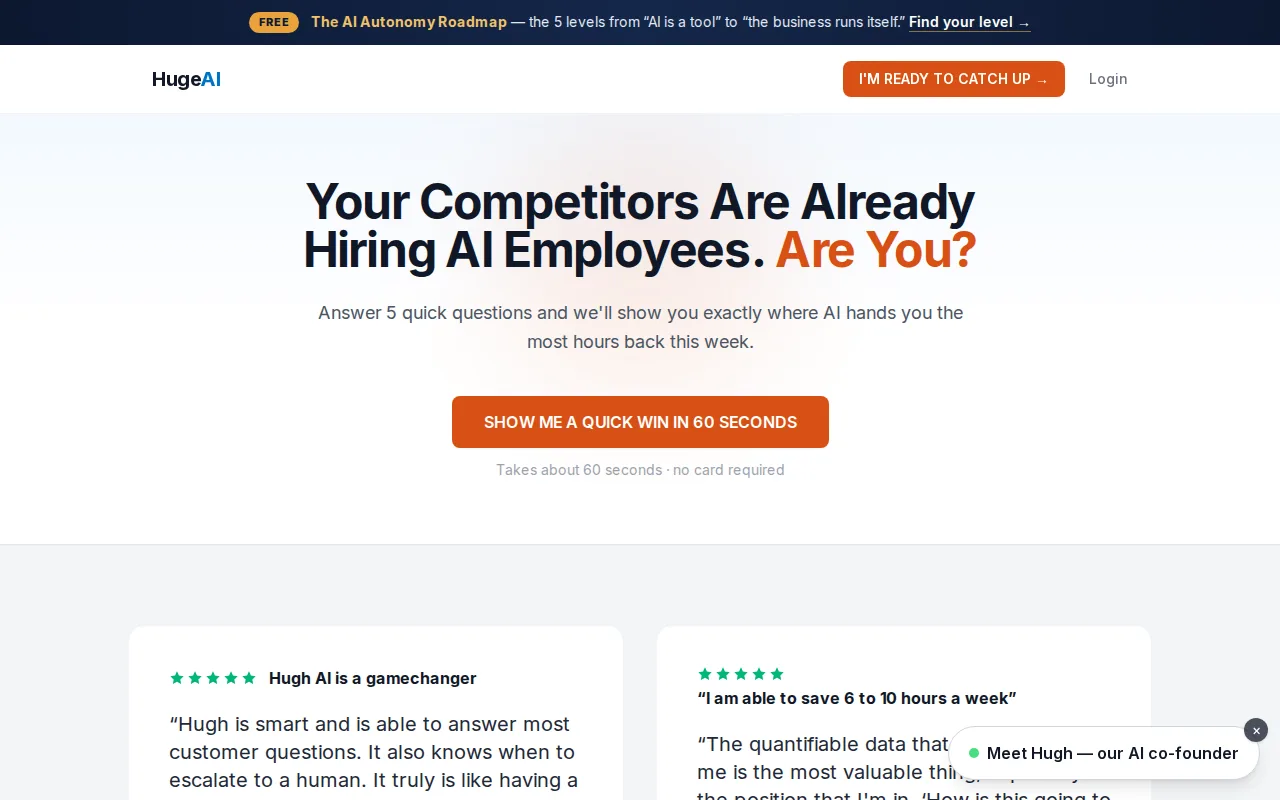
The starting point is a free 45-minute AI Growth Roadmap call. We map how your business actually runs, then send a same-day report with 3 to 7 prioritized fixes and estimated time and dollar impact for each. The roadmap is meant to help you choose what to do before you spend a dime building anything.
The next step depends on how hands-on you want to be. With AI Concierge, we work alongside you. With an AI Employee, we build and manage an AI system for a whole role, such as answering calls or following up on leads. Hugh, our AI co-founder, answers calls and books them.
For example, a trades business could start by tracking missed calls and the time spent on follow-up. The roadmap can help assess whether after-hours lead response is a better first use than a more complex task. The point is to choose a workflow with a measurable outcome, then keep a human involved where judgment matters.
We back the work with a 5+ hours-per-week time-saving guarantee. Ask how it applies to the specific work you’re considering, and what tasks would count toward the result. For more on matching a workflow to the business, see our AI implementation strategy for small businesses.
This route suits owners who want a plan first and hands-on implementation available after. If you want your own staff to own every build and daily change, an internal team may fit better.
2. AI Implementation Consultants for Owner-Led Businesses
An implementation consultant helps an owner turn a broad AI idea into one tested business workflow. This category can fit a business that has a clear task in mind but needs help mapping the work, setting a pilot, or guiding staff through the change.
A useful engagement should start with the current process, not a model demo. For a small agency, that could mean tracing a certificate request from the first client message through review and delivery. The consultant and business owner can mark each handoff, record how long the work takes, and decide which steps are safe to support with AI.
A measured pilot gives the team a way to compare new work with the existing process. Set a baseline first. Then agree on a quality bar, a review step, and a clear stop rule before the pilot handles live cases. A 90-day roadmap is one common planning shape in small-business guidance, but the calendar alone doesn’t prove a workflow is ready to expand.
Owner time is part of the cost. Expect the owner or project lead to spend some time each week coordinating access, test cases, and staff feedback. That effort can be worth it when the workflow has enough volume, but it should be visible in the plan rather than treated as free.
Consulting is a reasonable fit when your team can operate the system after the engagement. Ask who will own the workflow once the pilot ends, how issues get escalated, and what evidence will support a decision to continue or stop. Our AI readiness assessment guide covers the kinds of workflow and access questions an owner can settle before committing to a build.
For a business that needs ongoing build and support, a one-time consulting engagement may not cover the full operating work. Make that distinction early.
3. Insurance-Focused AI Implementation Services
Insurance-focused implementation support centers on agency workflows where client trust, data access, and human review matter. It may suit an independent agency that wants help assessing renewals, certificate requests, intake, or routine client communications.
Start with a narrow task. AI might sort an incoming request or prepare a draft response from approved agency information. A licensed or otherwise qualified team member should review advice about coverage, exceptions, or client-specific decisions before it goes out. That review point needs to appear in the workflow map, not just in a staff memo.
Before a pilot, identify which records the system can read and what it may write or send. Limit access to what the task needs. Decide how a staff member can correct an error, pause the process, and find a record of what happened. For a renewal workflow, for instance, the system might help gather missing information while an agency employee remains responsible for decisions and client advice.
Insurance rules and internal policies can change. Many states have adopted the NAIC Model Bulletin on insurers’ use of AI, carriers may pass those expectations on to their agencies, and a bad AI-drafted answer can still become an E&O problem. Confirm which requirements apply to your agency and business partners with your compliance lead or counsel.
A provider should be able to explain the review path in plain language. Ask how it handles a missing document, an unusual request, or a draft that may affect coverage. Our insurance AI options for brokers look at workflows and safeguards in more detail.
This category is a better match when insurance-specific review and privacy questions shape the project. If the main need is routine lead handling or office admin across a local service business, a broader automation provider may be the closer fit.
4. SMB Automation Agencies for Lead Response and Admin
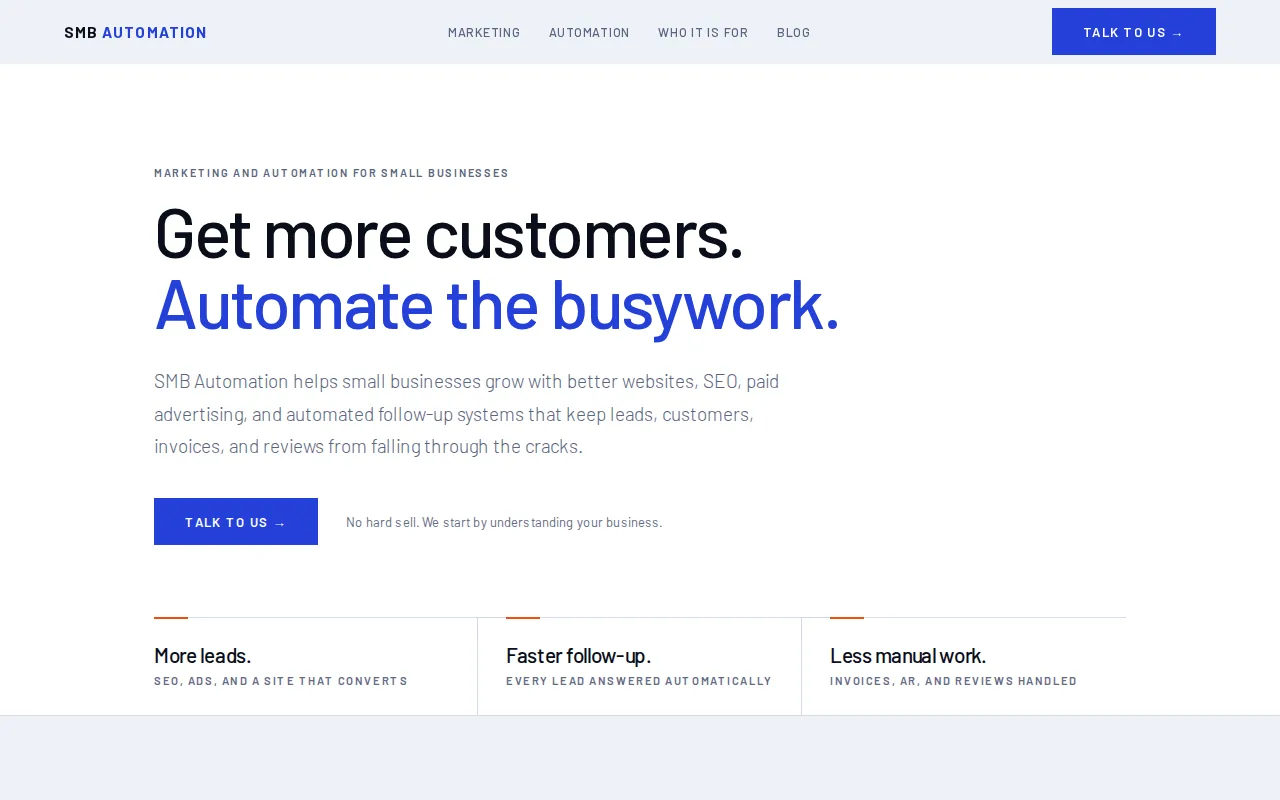
An SMB automation agency builds workflows around recurring service-business tasks. This category fits owners who lose time to missed inquiries, quote follow-up, or routine status messages and want help putting a bounded process into use.
Lead response can be a sensible first workflow because its start and finish are easy to define. A new inquiry arrives; the system gathers basic details and routes the request or offers a booking path. Set rules for requests that need a person, such as a complaint, an unclear job, or a question that calls for a technical judgment.
Quote follow-up is another candidate. A workflow can remind the team that an estimate needs attention, while a person reviews the message and handles replies that need context. In property management, a similar pattern might sort a routine request from one that needs a manager. The workflow should match your actual process, not a generic sequence copied from another business.
Before the system contacts customers or changes records, test it with sample cases and decide who checks exceptions. A risk-management resource is one reference; for a small team, practical steps include naming an owner, defining the task’s limits, testing likely failures, and assigning someone to handle issues.
One operational test is whether staff can return to the manual process if the system fails. Also decide what happens during an outage or when the system receives information it can’t use. Those details keep a small pilot from turning into a customer-facing problem.
We build and operate done-for-you AI for owners who don’t want to manage a new system themselves. If you’re comparing approaches to workflow automation, our overview of AI business process automation can help clarify where a service fits.
Choose this provider type when the target is a specific, repeatable task and you want outside help to build it. Keep the first pilot narrow enough that your team can review its work.
5. In-House AI Implementation Teams
An in-house team plans and manages AI work with people already in the business. This option can fit an SMB that has staff with the time and skills to own workflow design, testing, access, and ongoing review.
It doesn’t have to mean hiring a full technical department. A small team still needs a business owner who knows the process, a person who can manage the system or outside vendors, and staff who can test the workflow in daily work. If one person holds all those roles while also running the business, the plan may stall when urgent work takes over.
Sequence projects instead of launching several at once. Start with a workflow that has steady volume and a clear owner. Test it with human review, then wait for repeatable results before expanding the scope. A pilot that looks good in a demo isn’t proof that staff can run it during a busy week.
Keep a simple record of the system’s limits. Note which data it can use, which actions need approval, and who can pause it. Treat accountability as an ongoing responsibility, not a one-time sign-off. An SMB can apply that idea with a named owner and a short review routine.
Team adoption deserves its own attention. Staff need to know what the system does, when to check its work, and how to report a bad result. If a new process takes longer than the old one for a particular employee, find out why before assuming the person is resisting change. A short pairing session may reveal a missing shortcut or unclear instruction.
Our workflow automation examples for small businesses can help an owner spot tasks to assess. An in-house model makes sense when the people, access, and time to maintain the workflow are already available. If not, an outside partner can take on more of the build and operating work.
AI Implementation Roadmap Services Compared
The provider label matters less than who owns the work after the first plan. Use this comparison to narrow the choice, then test the fit against one workflow your staff already handle.
| Option | Good fit when | Owner’s role | Key check |
|---|---|---|---|
| Huge AI | You want a roadmap first, with implementation support available | Share how the work runs and decide which fix to pursue | Confirm the workflow, expected result, and review points |
| Implementation consultant | You need help planning and guiding a pilot | Provide process knowledge and coordinate staff | Name the person who owns the system after the engagement |
| Insurance-focused service | Client data and coverage-related review shape the task | Set review rules with qualified staff | Check access, approval, and escalation paths |
| SMB automation agency | You have a recurring lead or admin task to automate | Define exceptions and confirm service rules | Test the manual fallback and customer-facing messages |
| In-house team | You have staff time and skills for ongoing ownership | Assign internal roles and review results | Protect time for upkeep, not only the initial build |
For any provider, ask for a baseline, a measurable success rule, and a stop condition. A useful AI implementation roadmap should make progress visible in business terms, such as handling time or completed follow-ups, instead of relying on a polished demo.
FAQ: AI Implementation Roadmap Services
What should an AI implementation roadmap include?
An AI implementation roadmap should name a business workflow, its current baseline, the result to measure, and the person accountable for it. It should also show what data the system can use, where a human checks its work, and what happens when it fails. For an SMB, the first plan should focus on one bounded workflow rather than a company-wide rollout.
How long does AI implementation take for a small business?
Timing depends on the workflow, system access, data quality, and review needs. A narrow pilot may be planned over several weeks, while a more involved rollout needs more time to test and stabilize. Ask a provider to separate active work from waiting on approvals or access. Set a decision date, but expand only when the agreed evidence supports it.
Can a small business use AI without an in-house technical team?
Yes. A small business can work with an outside provider that plans, builds, and operates the system. The owner and staff still need to explain the workflow, set boundaries, and review the results. Huge AI’s free 45-minute AI Growth Roadmap is one way to identify a first workflow before committing to implementation.
How should an insurance agency protect client trust when using AI?
An agency should limit the system’s data access and keep qualified people responsible for advice and consequential decisions. Test drafts and edge cases before customer use, record who can approve actions, and make it easy to pause the workflow. Ask your compliance adviser how current regulatory guidance and internal policies apply to the specific use case.
What should we automate first?
Start with work that happens often, has clear steps, and has a result you can measure. Lead intake or routine follow-up may be easier to test than a task that depends on complex judgment. Compare the current time and error rate with the pilot result, including the time staff spend reviewing AI output. Stop or redesign if the evidence misses your agreed target.
Conclusion
For an owner who wants a plan before choosing tools or paying for a build, start with Huge AI’s free AI Growth Roadmap. Grab a 45-minute slot, bring one time-consuming workflow, and use the same-day report to decide what deserves a pilot.
Want an AI employee that answers every lead instantly?
That's what we build at Huge AI. One flat plan, no fine print.
See pricing →