AI Phone Answering Service Options for SMBs
Compare ai phone answering service options for small businesses, with guidance on call handling, intake, scheduling, integrations, and ROI.

Most AI phone answering services automate only part of the call load. Here are six options and service types for SMB owners who want fewer missed calls, cleaner intake, and a clear path to saved hours.
1. Huge AI
Huge AI is a done-for-you AI operations partner for owner-led businesses. We find the work AI can run, build the system, then operate it for you.

That makes Huge AI a strong fit when phone answering is only one piece of the problem. Maybe calls are missed after hours. Maybe leads reach the office but never get a fast reply. Maybe the owner still checks every intake form, books every estimate, or chases every follow-up.
We map how your business actually runs. Then we look at the handoffs around the phone call. A useful phone system may answer the caller, ask the right intake questions, book a slot, send a summary, and alert a human when the request needs judgment. The value comes from the full workflow, not from a voice that sounds human.
Huge AI works through three levels. The free AI Growth Roadmap is the no-risk starting point before you spend a dime building anything. In a 45-minute slot, we identify 3 to 7 possible fixes and estimate the hours and dollars tied to each one. Businesses can then choose AI Concierge support, or a fully managed AI Employee that we build and operate.
Our target is simple: recover at least 5 hours each week where the workflow fits the guarantee. The work that leaves your plate may include missed-call follow-up, appointment booking, lead qualification, or admin after a call.
Voice AI, smart routing, and virtual agents can reduce routine work while leaving complex or sensitive cases to human staff. That distinction matters in AI customer service.
The caveat is that Huge AI isn't a plug-and-play phone app. We first need to understand your process, tools, rules, and handoffs. That takes more thought than switching on a generic receptionist, but it also avoids paying for automation that creates more manual work.
2. AI Receptionist Services for Trades and Local Service Businesses
An AI receptionist for trades handles the first call while your crew works. It can collect the job type, service address, urgency, and preferred time before passing the request to your team.
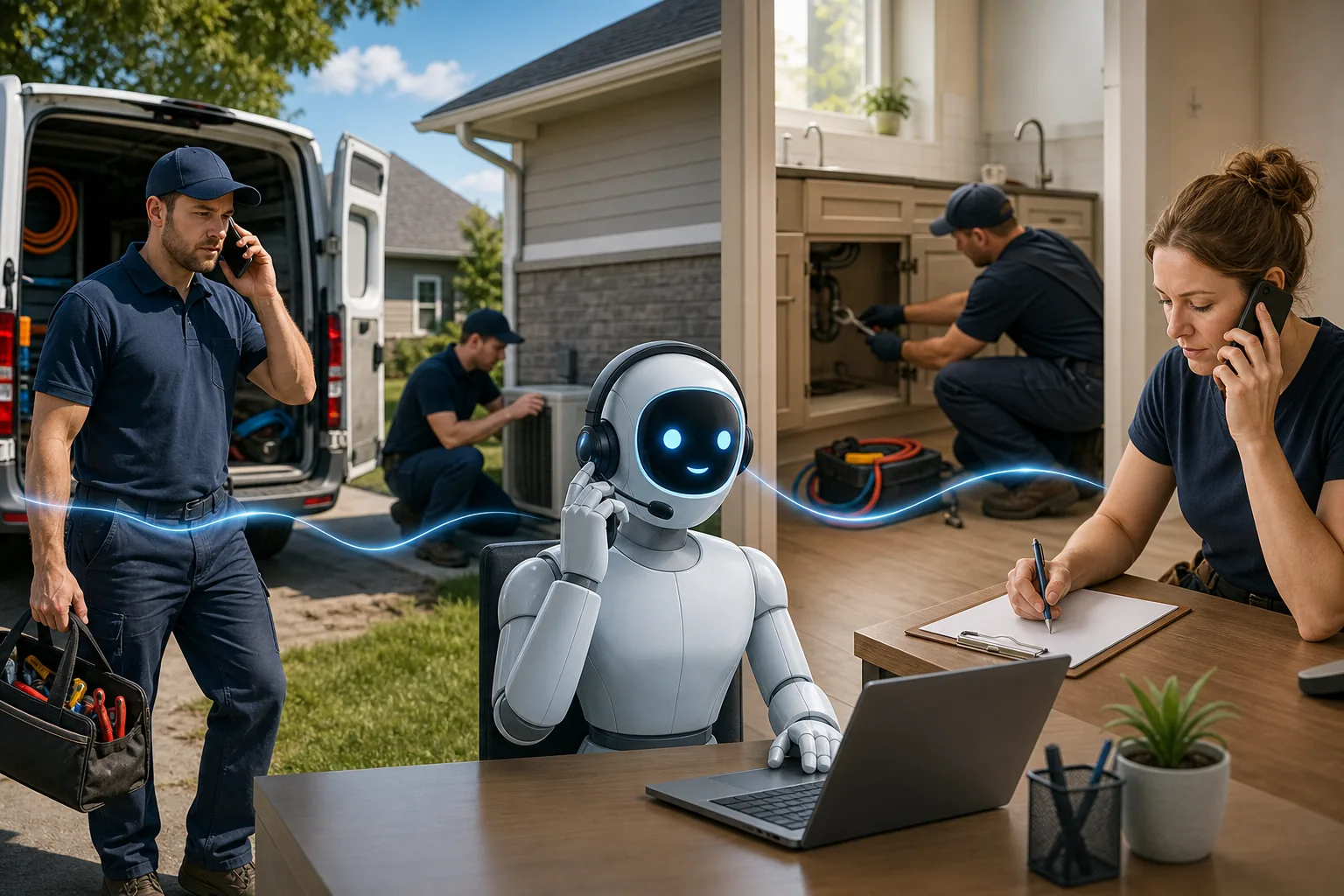
This category fits HVAC shops, plumbers, electricians, roofers, and similar firms. The owner may be on a job. The dispatcher may be helping a customer. A caller with a leaking pipe won't wait long for a reply, and a missed estimate request may go to another contractor.
Common call flows include:
- Answering after-hours calls with a clear business greeting.
- Asking what happened and whether the issue is urgent.
- Capturing the caller's name, address, and preferred callback time.
- Sending a structured message to the right person.
- Booking an appointment when the calendar connection works.
The important test is what happens after the call. A message in an inbox may still leave the owner with ten minutes of sorting. A useful intake flow gives the team a short summary with the details needed for the next action.
Trade software such as ServiceTitan, Housecall Pro, Jobber, and ServiceM8 was often missing from public integration details. That can force a manual handoff or a custom bridge.
Ask for a live test with your own call types. Use one routine request, one urgent request, and one caller who gives incomplete details. Then check whether the record reaches the right person without retyping.
The limitation is emergency handling. Many systems can identify words such as “flood” or “no heat,” but that doesn't mean they can dispatch a crew in real time. Keep a human escalation path for danger, active property damage, gas concerns, and any case your insurer or operating rules flag as sensitive.
3. AI Call Handling for Property and Short-Term-Rental Managers
AI call handling for property managers is built around guest and tenant requests. It works best when the answering service can read the right property data instead of giving a generic message.
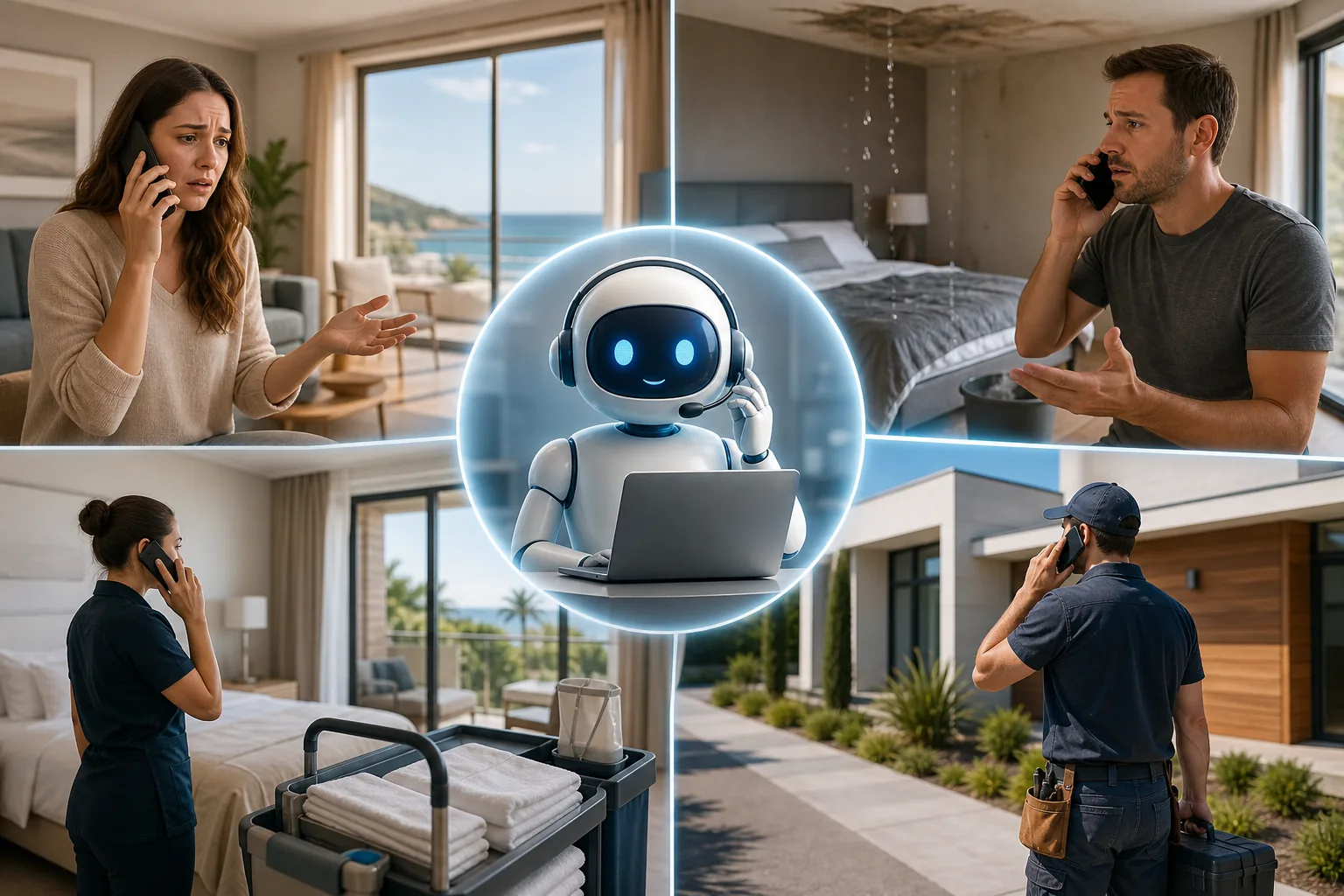
A short-term-rental manager may get a lockbox call late at night. A guest may need Wi-Fi details, parking rules, check-in help, or maintenance support. A message-taking service can record the request, but the guest still waits. A connected voice agent may solve the issue during the first call.
Some answering services connect a voice agent with property systems. These workflows may use reservation context, access-code support, property instructions, maintenance dispatch, and escalation with the call history attached.
That context changes the call. The guest doesn't need to repeat a booking code if the system can identify the reservation. A maintenance request can include the unit, issue type, and urgency. Your team receives a case it can act on, rather than a vague note that says, “Guest needs help.”
For a property manager, review these points before signing:
- Can the system read reservation details?
- Can it follow property-specific instructions?
- Can it issue or reset access details safely?
- Can it send a maintenance request to the current workflow?
- Does escalation include the transcript or a useful summary?
Property-focused answering services may support tenants, owners, leasing prospects, and maintenance calls. Some offer after-hours coverage, support for growing portfolios, and multi-property operations. That makes the category worth considering when the need is property-specific rather than general call capture.
The catch is data access. If the answering service cannot connect to your property management system, staff may still look up every reservation by hand. Test the lockout workflow before you judge the voice quality.
4. AI Phone Answering for Independent Insurance Agencies
AI phone answering for an independent insurance agency handles repetitive calls without making every client wait for a producer or service rep.
Good uses include policy-service intake, certificate requests, billing questions, renewal reminders, and appointment setting. The system should collect enough detail to route the work. “Please call me back” is not a useful intake record for a busy agency.
An insurance-focused answering system can support intake for auto, home, life, and health policies. It may capture service requests, answer questions from an agency knowledge base, create tickets, send emails, and notify staff. If it connects to rating platforms through an API, an agency still needs to confirm compatibility with its own setup.
That matters for independent agencies because service work has many small variations. A certificate request may need a holder name and delivery address. A policy change may need review by a licensed person. A billing call may need identity checks before anyone discusses account details.
Use an insurance-focused system only when its rules match your risk controls. Set clear limits around coverage advice, binding authority, payments, claims, and policy changes. The AI should hand off when a caller asks for a judgment that belongs to a licensed professional.
Compliance deserves a place in the first meeting. Ask how calls are recorded, where transcripts are stored, who can access them, and how the system handles personal data. Also ask how your agency will review errors. A polished voice does not reduce E&O exposure when the workflow gives wrong information.
Ask for evidence that the system can handle your call volume and insurance intake workflow. Request a test using your own scripts and sample calls.
For many agencies, the right first use is narrow. Start with certificate intake or appointment booking. Keep coverage decisions and unusual service requests with licensed staff until the workflow earns trust.
5. AI Receptionist Systems for Multi-Location Small Businesses
An AI receptionist system for a multi-location business helps one call flow serve several offices without losing local rules.
This fits businesses with separate branches, service areas, or teams that share a brand. A caller may need the nearest office. Another caller may have an existing appointment at a different location. The system must ask enough questions to route the call correctly.
AI auto-attendant systems can route calls by business hours, location, department, caller history, and priority. They can also provide call summaries, CRM sync, call recording, analytics, and spoken-language routing. Those features matter when managers need to review what happened across locations without listening to every call.
Start with a location map. Write down each branch, its hours, its service area, and the calls it owns. Then define what happens when the local team doesn't answer. A central queue may work for routine questions. An urgent service request may need a manager or on-call role.
A shared system also needs clean content. If one branch changes its holiday hours, the update must reach the greeting and routing rules. If two locations use different pricing or appointment rules, the AI must know which rule applies.
Look for:
- Location-aware routing.
- Different hours for each branch.
- Clear transfer rules.
- One place to review call summaries.
- Permission controls for local managers.
Don't assume more locations mean better value. A system that handles one generic greeting across every branch may sound tidy while sending callers to the wrong team. Test calls for each location, especially after hours and on holidays.
This category is a fit when call routing is the main pain. If the deeper issue is lead follow-up or admin, a done-for-you AI Employee may recover more time than an auto-attendant alone.
6. AI Answering Services for General Local-Service Intake and Follow-Up
General AI answering services handle common local-business calls when you need coverage but don't need a trade, property, or insurance workflow.
A typical flow starts when the caller reaches your existing business number. The AI greets the caller, asks why they called, and takes an action. That action might be appointment booking, lead qualification, message capture, a transfer, or a follow-up alert.
Voice agents can work with existing telephony, keep context during a call, use calendar functions, and transfer a call with a summary. Some can also connect with CRM, telephony, payment, and commerce systems. These details show what is possible, but you still need to confirm whether the exact connector fits your tools.
This broad category can suit a cleaning company, a small clinic, a local consultant, or a repair firm with fairly stable intake questions. The system doesn't need to know every internal process on day one. It does need a firm boundary around what it may promise.
A useful test script has five calls:
- A new lead asking for an appointment.
- An existing customer with a simple question.
- A caller who wants a human.
- An urgent request that needs escalation.
- A caller who changes their mind halfway through.
Measure the result. Did the appointment land on the right calendar? Did the lead record include the details your staff needs? Did the urgent call reach a person? Did the caller have to repeat the story?
The market data gives owners a reason to stay cautious. Across 35 reviewed services, the median automation scope was 24%, even though the average was 42.67%. A few broad systems can raise the average, while many services still handle only a limited share of calls.
No service in that dataset published a typical weekly-hours-saved figure or a free tier. That makes a pilot more useful than a feature page. Track call volume, human follow-up time, bookings, missed calls, and escalations before and after the test.
General systems are flexible, but flexibility can become context bloat. That means feeding the AI so much mixed information that it becomes harder to control. Keep the first workflow narrow. Add new call types only after the first one behaves well.
Compare AI Phone Answering Service Options
The right ai phone answering service depends on the work after the greeting. Use the matrix below to match the option to the problem you actually need to fix.
| Option | Best fit | What to test | Main risk |
|---|---|---|---|
| Huge AI | Owners who want a built and managed workflow | Hours recovered across calls and follow-up | Needs process review before build |
| Trade-focused AI receptionist | HVAC, plumbing, electrical, and field service teams | Job intake, urgency, and dispatch handoff | Weak native links to trade software |
| Property and rental call handling | Managers handling guest or tenant requests | PMS access, lockouts, and maintenance routing | Generic answers without property context |
| Insurance-focused phone AI | Independent agencies with repeat service work | Certificates, renewals, rating links, and escalation | Licensing, privacy, and E&O controls |
| Multi-location AI receptionist | Businesses sharing a brand across branches | Location rules, hours, and transfer paths | Calls routed to the wrong branch |
| General local-service answering | Stable, low-risk intake flows | Booking, lead capture, and human transfer | Limited automation once calls get complex |
Before you buy, ask for integration details in writing. Ask for a pilot with a weekly time-saved measure. Our AI ROI calculator guide can help you frame the hours, recovered revenue, and payback questions before the test.
A tool that answers every call but leaves your team with the same admin burden hasn't solved the whole problem. Score the handoff, not the greeting.
FAQ
What is an ai phone answering service?
An ai phone answering service uses conversational software to answer business calls and take defined actions. Depending on the setup, it may capture a lead, book an appointment, answer a basic question, send a summary, or transfer the call. The system should also explain when it hands a caller to a human.
How much of my call volume can AI handle?
AI may handle a small or large share of calls, depending on the workflow. In a reviewed set of 35 services, the average stated automation scope was 42.67%, while the median was 24%. That spread shows why you should test your own call mix instead of trusting a general market promise.
Can an AI receptionist book appointments?
Yes, an AI receptionist can book appointments when it has access to the right calendar and clear booking rules. Test availability checks, rescheduling, cancellations, and transfers. A system that only takes a message may still leave your staff doing the work you wanted to remove.
Can AI answering services handle emergency calls?
Some AI answering services can identify urgent language, but emergency triage and real-time dispatch remain common limits. Set rules for danger, property damage, medical issues, and other high-risk calls. The AI should escalate these cases with the caller's details and conversation history.
Are AI phone answering services safe for insurance agencies?
They can fit insurance agencies when the workflow has strict limits and human review. Ask about recordings, transcripts, access controls, data retention, and escalation. Keep coverage decisions, binding actions, and unusual policy requests with licensed staff until testing supports a wider role.
What should an SMB measure during a pilot?
Measure answered calls, qualified leads, booked appointments, transfer quality, and human follow-up time. Also track errors and calls that need correction. A useful pilot shows whether the system recovers hours each week, not only whether it can hold a smooth conversation.
Conclusion
Choose the option that fits the work after the call, not the voice on the greeting. For owners who want a managed workflow rather than another system to learn, start with Huge AI's free AI Growth Roadmap. Grab a 45-minute slot, map how your business actually runs, and decide which call task can recover 5 or more hours each week.
Want an AI employee that answers every lead instantly?
That's what we build at Huge AI. One flat plan, no fine print.
See pricing →