Business Automation Consultant Options for Small Businesses
Compare business automation consultant options for owner-led small businesses, from AI implementation to insurance and back-office workflow support.

A business automation consultant should help you recover time from work that repeats, not hand you another tool to manage. Here are six kinds of support, including Huge AI, and the workflows each can fit.
We analyzed 33 Reddit comments about business automation consulting and found that 18% mentioned implementation complexity.
1. Huge AI
Huge AI helps owner-operators find parts of the business AI can run, then builds and operates those systems. It suits a small business owner who is short on time and wants support with the work itself, not another app to learn.
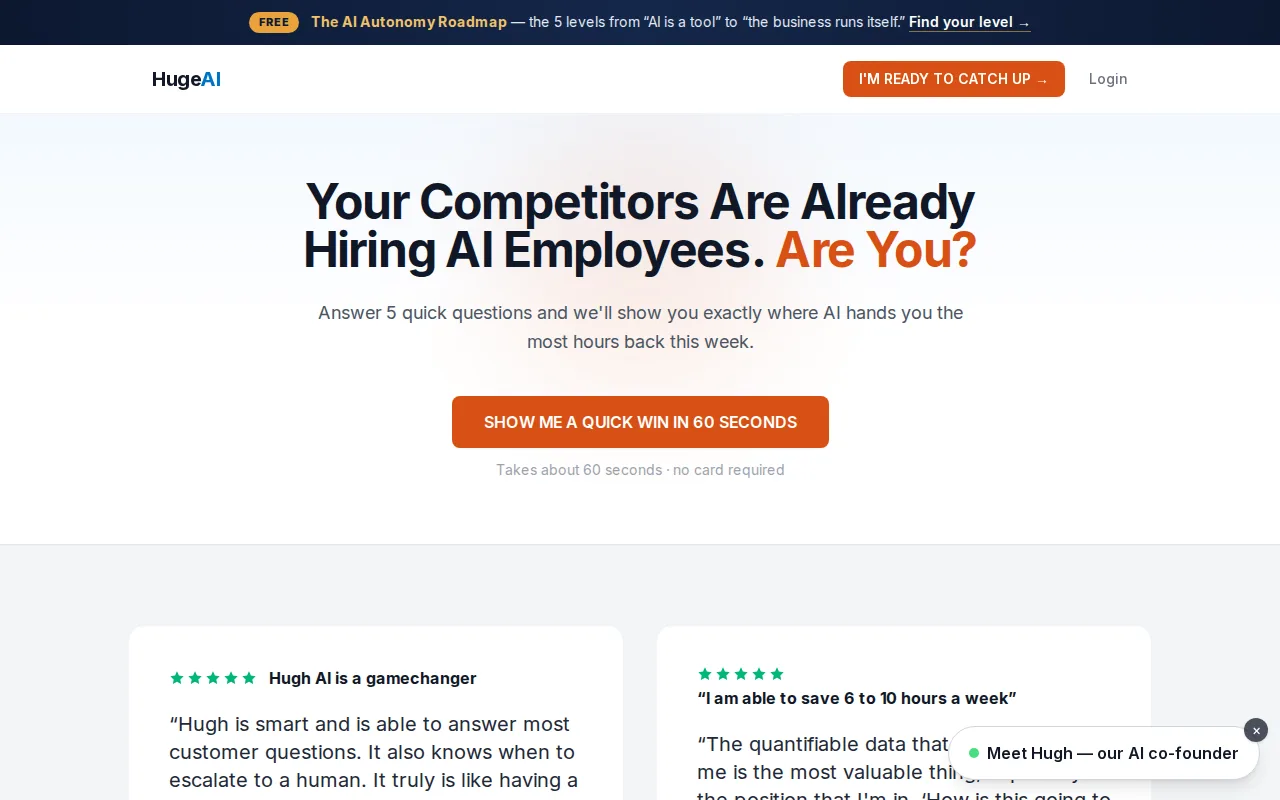
The starting point is a free 45-minute AI Growth Roadmap. We map how your business actually runs, then share a same-day report with three to seven prioritized fixes and the estimated dollar-and-hour return for each. That gives you a way to judge the work before you spend money building anything.
The roadmap can point to a small first change or a larger handoff. The next steps are done-with-you support through AI Concierge, or done-for-you AI Employees built around your business and operated by Huge AI. An AI employee can handle a defined role, such as answering calls, booking leads, or following up on quotes.
That operating model matters when an owner is the person who catches every missed call and remembers every follow-up. A system that only works when the owner checks it each day hasn't removed the handoff. Huge AI's approach is to build the system and keep operating it, with approval before an AI employee goes live.
Huge AI also guarantees 5+ hours saved per week. Treat that as a specific commitment to discuss during the roadmap, not a claim that every possible workflow saves the same amount.
For owners comparing the broader service models, our AI business process automation overview explains how a business can move from manual work toward managed automation.
Huge AI is a fit when you want a partner to own the build and ongoing operation. If you'd rather get a plan and build everything yourself, a consulting-only engagement may fit better.
2. Independent Business Automation Consultants for Owner-Led SMBs
An independent consultant usually works directly with an owner to define a specific workflow and decide whether it should be automated. This category fits a business that has a clear operational snag but needs help setting a sensible scope before paying for a build.
The strongest first conversation is about the current process, not a tool demo. Bring one repeated task, such as sorting incoming requests or moving details from a web form into a client record. A consultant should ask who handles each step, what information they use, and where a person must review the result.
Some workflows need a better handoff or a simple rules-based connection, not AI. A useful consultant can say so. Business process automation generally means using technology to carry out repeatable business processes, but that doesn't make every process ready for automation.
Ask for a scope that names the trigger, the information the workflow may use, where its output goes, and who checks exceptions. If the plan is to build a system, agree on what a successful test looks like before the work starts. Use sample cases that include the usual input and a few messy ones.
For example, a small service firm might receive a request by email, have someone copy the details into a tracking system, and then send a reply. A scoped project could focus only on capturing the request and preparing a draft reply for review. That narrow boundary makes it easier to spot a wrong or incomplete result before it reaches a customer.
An independent consultant can be a good match when you want a clear recommendation and direct access to the person doing the work. Check whether implementation, staff handoff, and later support are part of the agreed scope. Those are separate needs, even when one consultant can cover them.
Choose this type when the first problem is uncertainty about what to automate. If the main issue is a very specific industry workflow, a specialist may already understand its common handoffs.
3. Local-Service Automation Agencies for Lead Response and Scheduling
A local-service automation agency focuses on turning new inquiries into a clear next step, such as a booked appointment or a callback task. It can suit a contractor, repair firm, or appointment-based business that loses time when inquiries arrive while staff are working with customers.
Lead response is a useful place to look because the steps are often easy to see. A customer fills out a form or calls after hours. Someone needs to capture the details, decide who should respond, and make sure the lead doesn't sit untouched.
Put a number on it before you hire anyone. Count how many inquiries arrive each week, how long each one takes to handle, and what that time costs you. A consultant should help you use your own wage costs and task volume to estimate the value, rather than treating a broad percentage as your expected result.
When an agency discusses text follow-up, ask what message goes out, when it is sent, and how a customer can reach a person if the issue is unusual. Ask about response times and how customers experience the messages; your own communication rules should guide the workflow.
Check how the system handles a missed or failed handoff. If a new lead doesn't match the normal pattern, it should reach a staff member rather than disappear into an automated path. Also agree who owns the booking calendar and how changes get reflected.
This category is most useful when the bottleneck is lead response, qualification, or scheduling. If you have lots of inquiries but no consistent way to record their source or result, ask the agency to include that tracking in the project scope.
4. Insurance Workflow Automation Consultants for Agencies and Brokers
An insurance workflow specialist works around agency operations such as quote intake, renewals, certificates, endorsements, or billing reconciliation. This category suits independent agencies and brokers whose staff spend too much time gathering details and passing work between systems.
Start with a high-volume task that has a clear review point. Quote requests, for instance, may arrive through email, calls, forms, and attachments. A workflow can organize incoming details and prepare a cleaner handoff, while the producer or service team checks the information before it moves forward.
Renewals create another common pile of manual work. Staff may need to gather documents, check for updated information, and prepare a summary for review. An automation project can help collect and organize that material, but a person should remain responsible for coverage judgment and client advice.
Certificates of insurance need care too. An intake workflow can identify missing details or flag special wording for review. It shouldn't make an unapproved coverage decision just to clear a queue faster. Ask the consultant to show where human approval happens and how exceptions are routed.
For a U.S. agency, include compliance in the first discussion. Ask how the proposed workflow will handle sensitive client data, who can see it, what gets logged, and how the design accounts for the NAIC AI Model Bulletin and your E&O controls. The answers should be specific to your process and the systems you use.
Don't assume a project needs to replace your agency management system. A specialist may be able to work around existing records, documents, email, and internal steps. Confirm what connections are possible and what staff will still need to do by hand.
Our insurance workflow options for brokers cover use cases such as policy review and client service. For any proposed build, ask for a small test with real, authorized examples before expanding it to more policy or claim work.
This category makes sense when industry-specific review and client trust are central to the task. Keep decisions about coverage, advice, or claims with qualified staff unless your approved process clearly says otherwise.
5. CRM and Back-Office Automation Consultants
A CRM and back-office consultant focuses on moving information between sales and operations, so staff don't have to retype the same details or remember every follow-up. This type fits a business with disconnected records, repeated data entry, or manual invoice and onboarding steps.
A basic workflow might start when a new lead submits a form. The system records the inquiry, creates a follow-up task, and alerts the right person. A more involved project could connect that process to onboarding after a customer agrees to proceed.
Back-office work needs the same attention as lead handling. Invoice preparation, client setup, and scheduled reports can involve repeated steps across several systems. A strong project scope defines which record is the source of truth, what happens when a required field is missing, and who can correct a failed run.
Invoice work is a common example of a process with clear stages. The exact workflow for your business depends on how you create, send, and track invoices today. Keep payment records and accounting controls in view when planning any connection.
Before choosing a consultant, ask how they test failures as well as successful runs. A workflow that handles a normal lead but silently drops a duplicate or incomplete record can create more cleanup for the team. Agree on a way to flag exceptions and pause the automation if it behaves incorrectly.
Also decide who will monitor the workflow after launch. An outside consultant may build and document it, while your team runs it. Another arrangement may include ongoing operation. Neither is automatically right; the key is knowing who responds when a connection changes or a task fails.
Choose this category when the pain comes from repeated work across several systems. If your task depends on strict industry rules, pair a general workflow specialist with someone who understands those rules.
6. Industry-Specific Automation Consultants for Trades and Property Managers
An industry-specific consultant understands the work patterns of a trade or property business and can shape automation around them. This type is useful when the owner is also the dispatcher, or when maintenance requests and tenant questions keep pulling the team away from planned work.
For a contractor, the daily problem may be a crowded inbox and constant job changes. A specialist can examine how new requests reach the team, how someone assigns the next action, and how customers learn about a schedule change. The first target should be a repeated handoff, not an attempt to automate every part of running a job.
Property managers face a different stream of work. Rental inquiries can arrive outside office hours. Maintenance requests need to be logged and sent to the right person. Owner updates may require someone to gather information from several places and turn it into a clear summary.
A property workflow should keep the property management system as the place staff trust for core records. Automation may help collect a request, sort it for review, or send a status update. For a likely emergency, it can alert the on-call person, but a person should decide what action to take.
Before a project starts, ask which systems it must connect to and what data can move between them. Then test a routine request and an urgent one. Make sure the team can correct a bad classification, update a contact, or pause a message without waiting for the original builder.
Owners often want the same result: fewer interruptions and faster follow-up. But the workflow differs by trade and property type. A trades business may care most about intake and dispatch, while a property manager may need a cleaner path from tenant message to maintenance log.
Our property management automation options discuss how inquiry handling and maintenance work can fit into an existing operation. For hands-on help, bring a recent example with personal details removed and ask the consultant to map the handoff before recommending a system.
Pick an industry specialist when the cost of misunderstanding the work is high. If the workflow is common across many business types, a general consultant may be enough.
Compare Business Automation Consultant Options by Fit
Use the main bottleneck to narrow your shortlist. The right fit depends on what you need someone else to own, not how much AI a provider puts in a pitch.
| Option | Best fit | What to confirm |
|---|---|---|
| Huge AI | Owners seeking a roadmap, then managed AI support | Which tasks are in scope and who reviews exceptions |
| Independent consultant | Owners who need a defined workflow and plan | Whether build work and ongoing support are included |
| Local-service agency | Lead response, qualification, and scheduling | How missed handoffs reach a staff member |
| Insurance workflow specialist | Agency admin with client or policy review needs | Human approval, data access, and audit controls |
| CRM and back-office consultant | Repeated work across sales and operations systems | Failure handling and post-launch ownership |
| Industry-specific consultant | Trade or property workflows with specialized steps | Fit with the records and tools already in use |
Ask a provider to estimate your own workload using task volume, staff time, and review effort rather than relying on a general percentage.
For a small business, a sensible first project has one owner, a repeatable input, a clear output, and a person who can check unusual cases. If those basics aren't in place, improve the process before paying to automate it.
FAQ
What does a business automation consultant do?
A business automation consultant finds repeated work that can be handled with a defined workflow, then helps scope or build the change. The work may involve lead follow-up, scheduling, CRM updates, or back-office handoffs. Ask whether the engagement includes implementation and ongoing operation, because advice, building, and support can be separate parts of the scope.
How do I choose an automation consultant for a small business?
Choose a consultant who can map one real workflow and explain how the system handles mistakes or exceptions. Bring a task your team repeats and ask for the expected output, human review points, and success measure. A good first project has a clear owner and doesn't require automating the whole business at once.
Can AI automation help an independent insurance agency?
Yes, it can help organize repetitive work such as quote intake, renewal document collection, or certificate requests. Keep a qualified person responsible for coverage decisions and other work that needs professional judgment. Ask how the proposed process handles client data, approvals, records, and your compliance responsibilities before it goes live.
How many hours can business automation save?
There isn't one reliable number for every business. Estimate your own result by measuring how long the task takes now, how often it happens, and how much human review the new process still needs.
Should I hire a consultant or build automations myself?
Build it yourself when the workflow is simple, low risk, and easy to check. Hire help when it spans several systems, has unusual cases, or needs ongoing support that your team can't own. If you aren't sure what should come first, Huge AI's free AI Growth Roadmap is a way to discuss likely fixes before committing to a build.
Conclusion
Choose a provider around the work that's costing you the most time, then ask how results and exceptions will be measured. For owner-led businesses that want the roadmap and the build operated for them, start with Huge AI's free 45-minute AI Growth Roadmap and bring one process you want off your plate.
Want an AI employee that answers every lead instantly?
That's what we build at Huge AI. One flat plan, no fine print.
See pricing →