Custom AI Agent Development Company Options
Compare custom ai agent development company options for small businesses, with use cases, security checks, integrations, costs, and ROI guidance.

AI can answer a question. A well-built agent can take a job, make a plan, use your business systems, and bring back a finished result. That difference matters when your inbox, intake queue, or renewal list keeps stealing your week. Here are ten provider types to consider, with Huge AI first for owners who want the AI built and operated for them.
1. Huge AI, done-for-you AI Employees for owner-led businesses
Huge AI helps owner-operators find work that AI can run, then builds and operates the system for them. It fits a plumbing company that loses leads after hours, an insurance agency buried in renewals, or a property manager stuck in email all day.
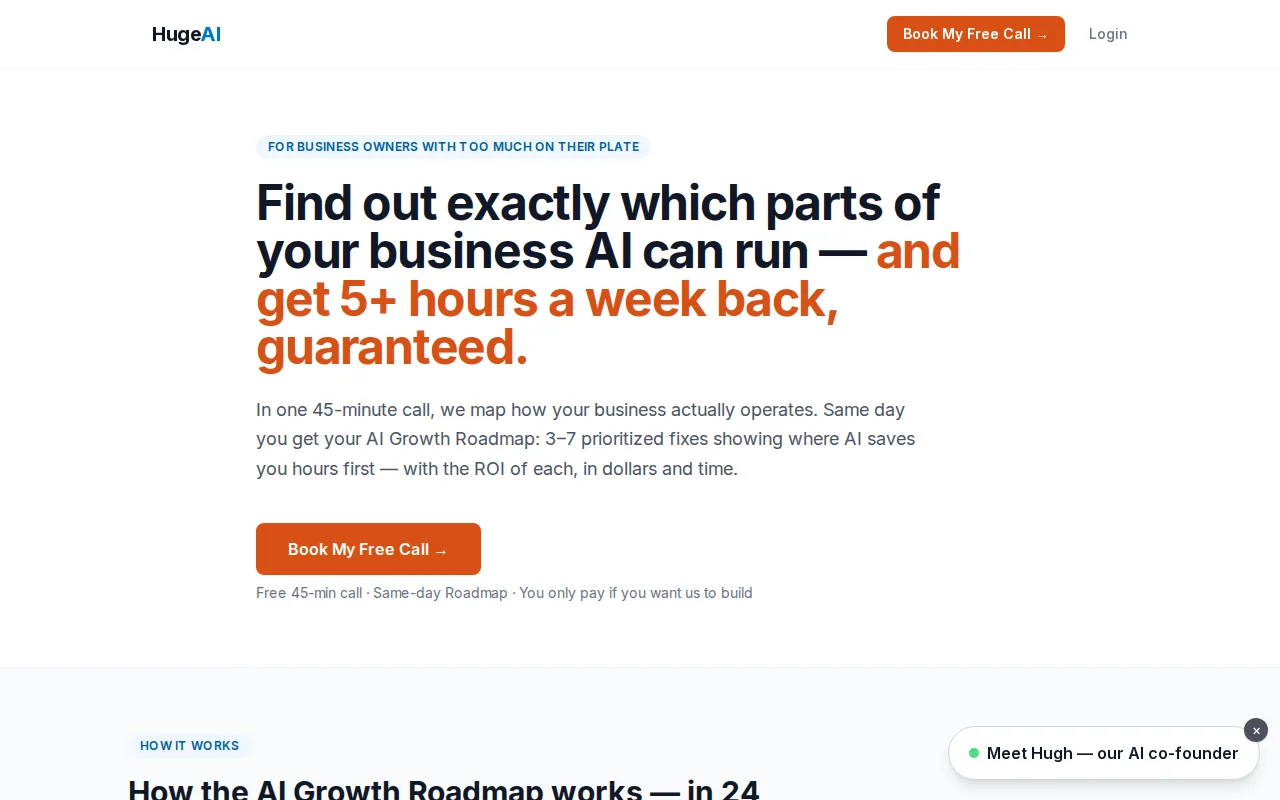
We start with a free 45-minute AI Growth Roadmap. The same-day report lists 3 to 7 possible fixes and estimates the hours and dollar return for each one. That gives you a useful decision before you spend a dime building anything.
The delivery path can move from do-it-yourself guidance to done-with-you support, then to fully done-for-you AI Employees. The last option is built and run for you. You don't have to learn a new app or babysit a prompt every morning. We map how your business actually runs, then work component by component.
A strong first use case has a clear finish line. For example, an AI employee could sort new inquiries, ask for missing job details, draft a reply, and flag high-value leads for you. It should also know when to stop and hand work to a person.
The caveat is simple. Huge AI is a fit when you want an outcome, not another software account. If you only need a blank platform for your own technical team, a specialist developer may fit better.
2. Workflow automation specialists for lead response, intake, and scheduling
A workflow automation specialist is a sensible fit when your process is clear and repeats each day. A custom AI agent development company in this category may connect a form to an inbox, read the request, ask a follow-up question, and route the lead to the right person.
This works well for service businesses. A new HVAC inquiry may need the property address and system type. An insurance prospect may need a policy class and renewal date. The agent can gather those details before a producer or technician spends time on the lead.
Ask to see the handoff rules. What happens when a lead gives an unclear answer? Does the agent create a draft or send it? Can a manager review the message before it leaves? Good workflow design makes those choices plain.
Calendar access needs care, too. The agent should check real availability rather than guess. It should also avoid booking work that needs a licensed professional or a site visit until a human approves it.
We often point owners toward a done-for-you AI receptionist for small business when calls and scheduling are the main bottleneck. The right setup depends on where leads arrive and who owns the next step.
3. Insurance workflow partners for renewals, certificates, and client communications
Insurance workflow partners focus on repeated work that moves between an agency inbox, client records, carrier documents, and staff review. This category of custom AI agent development company can help with renewal prep, certificate requests, document sorting, and draft client updates.
Start with low-risk support work. An agent might find missing information in a renewal file, compare the request against a checklist, or draft a note for an account manager. It should not make coverage decisions or send a binding statement without the right human check.
Security questions matter here. Ask where client data is stored, how long logs remain, who can view them, and how access is removed. Ask for a written answer, not a broad promise that the system is secure.
Insurance agencies also need an error trail. If an agent changes a draft or pulls data from a file, the reviewer should be able to see what happened. This helps with quality checks and can reduce E&O risk when a process goes wrong.
A clear framework for governance, fairness, and oversight is useful when reviewing an agency's AI process. Treat compliance review as part of the build, not a task for launch week.
4. End-to-end AI agent development firms for complex builds and support
End-to-end firms handle a broad build. A custom AI agent development company in this group may cover agent design, system integration, deployment, and ongoing support. Ahex Technologies is described in the research set as an end-to-end provider with secure API and cloud integration support.
This model fits a business with several systems and no internal team to join them. Think of an agency with a CRM, shared drive, email, calendar, and document store. The firm must turn a business process into a set of rules, permissions, tools, tests, and review points.
The risk is scope creep. “Build us an agent” can turn into a long project with no clear result. Set a first release around one job. Define the input, the expected output, the systems it may touch, and the cases that need a person.
Ongoing support should include a way to report errors and review agent runs. Ask who owns prompt changes, connector failures, access updates, and model changes after launch.
5. Document-processing agent specialists for forms, inboxes, and policy files
Document-processing specialists build agents that read files and turn their contents into useful work. A custom AI agent development company in this category may handle forms, inbox messages, PDFs, policy files, or vendor records.
The best use cases have a clear review rule. An agent can classify a document, pull out a date, spot a missing field, or place the file in the right queue. It can then show the source page or passage so a staff member can check the result.
Ask how the system handles poor scans, tables, handwritten notes, duplicate files, and conflicting values. A demo using clean sample documents tells you little. Give the provider a small set that reflects your daily mess.
Retrieval-augmented generation, often called RAG, lets an AI system look up approved company material before it answers. That can help with internal files, but it doesn't remove the need for access control or source checks.
Document agents can save review time, but only when the workflow names the point where a person takes over.
6. API-connected agent integrators for CRM, email, calendar, and business systems
API-connected integrators focus on the bridge between the agent and your existing systems. A custom AI agent development company in this category may connect CRM records, email, calendars, internal files, or business APIs.
Integration is where many proposals become vague. Research across 21 company profiles found that agent capabilities were described far more often than integration support. Nearly half of the profiles explicitly listed no integration support, while only about half mentioned it at all.
Ask for a system map before you approve a build. It should show what the agent can read, what it can write, and what needs approval. A calendar agent that can read availability but cannot create a booking is different from one that can send invitations without review.
Access should follow the least-privilege rule. Give the agent only the permissions needed for its job. Use separate credentials where possible, and remove them when a staff member or vendor leaves.
Integration examples include CRM, Slack, Gmail, Google Calendar, Google Docs, and Google Drive. That level of detail is more useful than a proposal that only says “integrates with your stack.”
7. Research and knowledge-agent builders for internal answers
Research and knowledge-agent builders make internal information easier to use. A custom AI agent development company in this category may build an agent that searches approved documents, summarizes findings, and cites the material it used.
This can help an owner answer questions without stopping a staff member. A property manager might ask about a building rule. An agency manager might search a carrier guide. A service business might pull the right warranty procedure before a callback.
Source quality matters more than a clever chat window. Ask whether the agent can show its source, mark uncertain answers, and refuse when it finds no approved material. An answer without a source is a draft, not a business record.
Good knowledge work also needs a content owner. Someone must remove old policies, add new procedures, and decide which files the agent may use. If the source folder is messy, the answer will be messy too.
For many small firms, this is a better first project than a fully autonomous agent. It gives staff faster answers while keeping the final decision with a person.
8. Multi-agent orchestration teams for work that passes through several roles
Multi-agent teams split a larger job into separate roles. One agent may gather facts, another may check the result, and a third may prepare a draft for review. Research profiles describe this pattern through terms such as multi-agent architectures and coordinated agent systems.
This can fit a process with clear handoffs. Picture a renewal workflow. One agent finds the account file. Another checks the renewal checklist. A human reviews the exceptions before a final draft goes to the client.
More agents mean more moving parts. Each handoff can lose context or pass along a bad assumption. Keep the first version small. Log each stage, set a time limit, and make the system stop when a required field is missing.
Don't choose a multi-agent design because it sounds advanced. Choose it when separate roles make testing easier or when one agent cannot safely handle the whole job.
9. Production monitoring and governance partners for controlled deployment
Monitoring and governance partners focus on what happens after launch. A custom AI agent development company in this category helps track runs, review failures, manage permissions, and keep a person in control of sensitive actions.
Ask what gets logged. Useful records may include the input, the tools used, the output, the approval step, and the final action. Logs should protect private data while still giving managers enough detail to investigate an error.
Set a review rhythm. A small business may review failed runs each week at first. Later, the team can focus on exceptions, high-risk actions, and changes in source data.
Governance also covers model choice. Claude, Microsoft Copilot, LangChain, and LangGraph may appear in a build, but the name of the model doesn't tell you whether the workflow is safe. The design of permissions and handoffs matters more.
A risk-management framework gives organizations a structure for thinking about AI risks and controls. Use it as a question list when a provider shows you a deployment plan.
10. Product-focused agent development teams for repeatable experiences
Product-focused teams build an agent into a repeatable customer or staff experience. A custom AI agent development company in this category may work on a customer portal, an internal service desk, or a guided intake flow.
This model fits a business with one experience it wants to repeat. A customer could submit a request, receive a clear status update, and see the next step without waiting for staff to answer every basic question.
Ask what happens outside the happy path. Can the agent pass a complaint to a person? Can staff edit a wrong answer? Can you change the approved source without rebuilding the whole system?
Product work also needs a clear owner. Decide who approves new content, checks user feedback, and reviews the agent when your service rules change.
A polished interface won't fix a weak process. Define the job first, then decide how the user should meet it.
Compare the 10 custom AI agent development company options
The right provider depends on the work you want off your plate. Use this table to narrow the field before you request proposals.
What to look for before hiring a custom AI agent development company
Start with the business result. “Use AI in operations” is too broad. “Draft every new lead reply within ten minutes and flag urgent jobs” gives a provider something to design and test.
Then ask the provider to show the path from input to result. You should see the source data, the tools the agent uses, the approval points, and the final record. If the proposal only describes the model, it is missing the part that makes the system useful.
Check these areas before you compare quotes:
- Integration: Confirm each system the agent can read or change. Ask how failed connections are handled.
- Security: Ask about data storage, access rights, logs, retention, and staff removal.
- Delivery: Find out whether the provider gives advice, builds with you, or builds and operates the system.
- Human review: Mark every action that needs approval. Sensitive client messages should not leave unchecked.
- Measurement: Pick one baseline, such as owner hours, response time, or completed files per week.
- Support: Ask who handles errors after launch and how changes are tested.
Pricing is hard to compare in this market. In a review of 21 company profiles, only one disclosed a pricing model. That profile listed ELEKS at $25 to $49 per hour. Treat that as a single published example, not a market rate.
Build versus buy also comes down to ownership. A pre-built tool may work when your process matches its template. A custom system fits better when your rules, data, and handoffs are unusual. Huge AI's free AI Growth Roadmap gives owners a way to test the likely return before choosing either path.
FAQ about custom AI agent development companies
What does a custom AI agent development company do?
A custom AI agent development company builds an AI system around a specific business job. It may connect company data, email, calendars, documents, or APIs so the agent can complete several steps. The provider should also define approvals, test the workflow, and explain who supports it after launch.
How is an AI agent different from a chatbot?
An AI agent can plan and act across a workflow, while a chatbot usually answers a prompt. An agent may gather context, choose a tool, complete a task, check the result, and ask for help when needed. The difference is the work loop, not the chat window.
How much does custom AI agent development cost?
Custom AI agent development costs vary with the workflow, system access, testing needs, and ongoing support. Published pricing is rare. One research profile listed ELEKS at $25 to $49 per hour, but that figure isn't a quote for your project. Ask for a scoped first release and an ROI estimate.
Can a small business use a custom AI agent without a developer?
Yes, a small business can use a custom AI agent without hiring a developer. The provider can build and operate the system while the owner approves goals and business rules. Huge AI starts with a free 45-minute AI Growth Roadmap, then can support done-with-you or fully done-for-you work.
What systems can an AI agent connect to?
An AI agent can connect to systems that provide suitable access, such as a CRM, email account, calendar, document store, or business API. The exact connection depends on permissions and the system's interface. Ask for a written map of what the agent can read, write, send, or delete.
Are custom AI agents safe for insurance work?
Custom AI agents can support insurance work when people control sensitive decisions and client communications. Use them first for sorting, drafting, and missing-data checks. Require logs, access limits, source checks, and human approval for coverage or binding actions. Review the NAIC guidance with your compliance adviser.
Conclusion
For an owner-led business, choose the provider that can tie one repeated job to a measurable return. Huge AI is the clearest starting point when you want the system built and operated for you rather than another tool to manage. Grab a 45-minute AI Growth Roadmap before you spend a dime, and use the report to decide what deserves a build.
Want an AI employee that answers every lead instantly?
That's what we build at Huge AI. One flat plan, no fine print.
See pricing →