AI Implementation Consultants for Small Business
Compare AI implementation consultant options for small businesses by workflow fit, compliance, ROI, and hands-on support.

Most small businesses don't need another AI app. They need someone to find the work AI can run, build the system, and keep it working.
Free consultation offers are scarce, and ROI details can be hard to find. Here are the options worth considering, starting with the clearest path for owners who want help without taking on another technical project.
1. Huge AI
Huge AI is an AI implementation consultant for owners who need work taken off their plate, not another system to operate. We map how your business actually runs, find tasks that AI can handle, then build and operate the system for you.
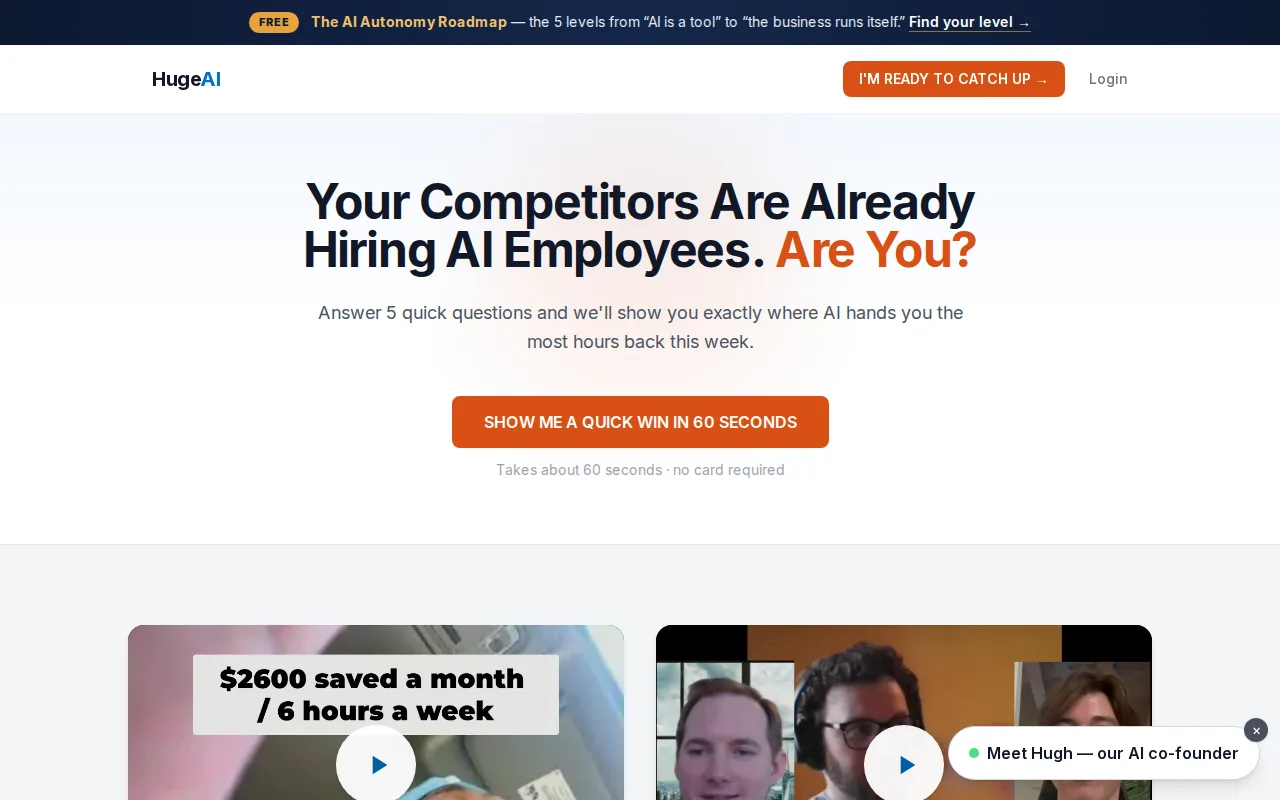
That starts with a free 45-minute AI Growth Roadmap. Before you spend a dime building anything, the session identifies 3 to 7 possible fixes. The same-day report puts an estimated dollar and hour value beside each one, so you can decide what deserves attention first.
That order matters. A small HVAC company may need faster after-hours lead response. An insurance agency may need help with renewal prep, certificate requests, or routine client messages. A property manager may lose time to guest questions and vendor follow-up. The right starting point depends on where work piles up in your business.
Huge AI has a three-part service path:
- The AI Growth Roadmap finds and ranks the work.
- AI Concierge provides done-with-you support.
- AI Employees provide done-for-you systems that Huge AI builds and operates.
The last option is aimed at whole business functions. Think of an AI employee as a machine that never quits. It may handle a defined workflow such as lead intake, follow-up, appointment booking, research, or internal admin. Your team still sets the rules and reviews the work that needs human judgment.
Huge AI also ties its implementation work to a 5+ hours per week time-saving guarantee. That gives an owner a clear test. If a proposed workflow can't plausibly save that kind of time, it may not belong at the front of the queue.
The caveat is simple: AI still needs boundaries. A system that touches customer records, insurance details, pricing, or client advice needs access rules and human checks. Huge AI is a fit when you want a partner to handle those build and operating tasks rather than hand you a login and a list of tutorials.
Good fit: owner-led firms with repeated admin work, missed follow-up, or a growth plan that depends too heavily on the owner's hours. If you're unsure where to begin, the free roadmap is the sensible first move.
2. Boutique AI Implementation Consultants for Service SMBs
A boutique AI implementation consultant can fit a service business that needs hands-on integration without a large corporate program. This category suits owners who already use a field service system, CRM, accounting tool, or shared inbox but can't make the pieces work together.

Home service firms face a particular set of workflow problems. Dispatchers adjust schedules during the day. Technicians work away from the office. Customer records sit beside job data, payment details, and service history. An AI plan that ignores those facts usually fails at handoff.
For a trades business, useful work may include:
- Qualifying a new lead before a dispatcher reviews it.
- Booking an appointment after an after-hours inquiry.
- Flagging a missed service window before the customer calls.
- Matching a job with the right technician based on skills and location.
- Spotting service agreement customers who may need a follow-up.
The consultant's platform knowledge matters here. The research on AI consulting for home services points to field service systems, CRM records, marketing tools, accounting software, and communication channels as parts of the same integration problem. AI may be the visible layer, but clean handoffs between systems often decide if the workflow works.
That is why we would ask a boutique firm to draw the current process before suggesting a tool. Start with the call. Then follow the lead through booking, dispatch, job completion, billing, and review requests. Any gap in that chain can waste the time the AI was meant to save.
The strongest firms in this category can also put a number beside the business case. The cost of a missed service window is not abstract. Neither is technician idle time or a lead that never gets a reply. Ask the consultant to show which measure will move and how you will check it.
Research on home service consulting also points to custom work such as data pipelines, demand forecasts, diagnostic assistants, and quality checks. That level of work may help a multi-location operator, but it can be too much for a single-shop owner with one clear bottleneck.
For a wider look at workflow fit and ongoing support, our AI consulting firms for small business comparison gives owners another way to screen providers.
The limitation is capacity. A small firm may give you senior attention, but it may have less room for a long rollout across many locations. Get clear on who will build the work, who will monitor it, and what happens when your process changes.
3. Insurance-Focused AI Consultancies
An insurance-focused AI implementation consultant works around agency workflows such as renewals, intake, certificates, quoting support, and client communication. This choice makes sense when the cost of a wrong answer is higher than the cost of a slow reply.

Independent agencies have many tasks that look routine but still need care. A certificate request may be simple in one case and unclear in the next. A renewal packet may contain missing information. A client email may ask for an answer that depends on a policy detail or carrier rule.
A useful system should sort the work before it acts. It might pull a request into a queue, check whether required fields are present, draft a reply, and send uncertain cases to a licensed team member. That keeps AI away from decisions it should not make while reducing the time spent on basic handling.
We would put renewal support near the top of the list for many agencies. The system can watch for upcoming work, gather approved information, flag gaps, and prepare a review packet. The account manager still decides what goes to the client. The point is to reduce the hunt through files and inboxes.
Certificate workflows need the same care. The AI should not invent coverage terms or send a certificate without the right approval. It can help read the request, identify missing facts, route it to the right person, and draft a message that a human checks first.
Compliance belongs in the first meeting. The NAIC's Model Bulletin on the Use of Artificial Intelligence Systems discusses governance expectations for insurers using AI systems. An agency should still check its own state rules, carrier agreements, E&O controls, and data policies before putting a workflow into production.
Ask any insurance consultant these questions:
- What data can the system read?
- Which actions require human approval?
- How are prompts, drafts, and final messages logged?
- How can staff correct a bad result?
- What happens when a carrier or state rule changes?
The fit is strongest when the agency wants to reduce admin load while keeping licensed staff in control. It is weaker when a provider makes broad claims about replacing judgment or treats compliance as a final checklist.
Huge AI can also start with a workflow review rather than a software purchase. That distinction helps an owner decide if renewal prep, intake, follow-up, or another task deserves the first test.
4. Embedded, End-to-End AI Consultancies
An embedded, end-to-end AI consultancy stays close to the business through planning, build work, rollout, and ongoing operation. This model is for an owner who knows the team needs help but doesn't have an internal person to manage the project.

The consultant may begin by sitting with the people who do the work. A dispatcher explains how urgent jobs move. An account manager shows how renewal files are checked. An office manager points out the spreadsheet that everyone depends on but no one trusts. Those details shape the system more than a generic AI demo does.
The engagement should produce a clear operating brief. It should name:
- The workflow being changed.
- The person who owns the final decision.
- The records the system can access.
- The point where a human must review the output.
- The measure used to judge time saved or revenue recovered.
Then comes a small pilot. Suppose a plumbing company wants to handle after-hours leads. The first test might cover only web inquiries during evenings. The system captures the job type, service area, and preferred time. It asks a human to review anything unclear. After the pilot, the owner can see response time, booked jobs, and exceptions before expanding the scope.
Ongoing operation is the part many proposals leave vague. Who watches failed automations? Who updates a prompt when staff change a form? Who checks if a vendor changes its connection? Who reviews the monthly savings claim?
An embedded consultant answers those questions before the launch. That is helpful for a small company because the owner should not become the unpaid product manager. Still, this model needs a firm scope. “End to end” can become expensive if every new idea enters the same project.
Huge AI's Roadmap, AI Concierge, and AI Employee path follows this same basic concern: match the amount of support to the owner's need. Some businesses want help beside their team. Others want the system built and operated for them.
Choose an embedded model when the business needs a long-term operator. Choose a narrower project when the work is already well defined and the team can own it after launch.
5. Enterprise AI Implementation Consultancies
Enterprise AI implementation consultancies bring wide teams and broad delivery capacity. They fit complex organizations with many data sources, formal governance needs, or large programs that span several departments.

Large consultancies can help with a program that needs separate workstreams. One team may review data access. Another may build the integration. A governance group may set review rules. A change team may train staff across many offices. That structure has value when the organization truly needs it.
It can also create friction for a small firm. The owner may spend more time in discovery meetings than the original task required. Pricing is often not clear on the public site.
Enterprise providers also tend to fit financial institutions better than a local trades company. If your main problem is a backlog of estimate requests, a global program may be the wrong tool for the job. A smaller consultant can often get closer to the workflow with fewer layers.
If you still want this route, ask for a named delivery team. Ask who will attend the weekly call. Ask what work stays in scope. Ask for a pilot that proves one operating result before a broad rollout.
Don't accept a productivity percentage without the measurement plan. Define the baseline first. If staff spend six hours each week on renewal preparation, the target should relate to that work. A broad claim about AI productivity tells you little about the queue your team faces every Monday.
Large firms make sense when governance, scale, and integration complexity justify the overhead. For most owner-led service businesses, a focused implementation partner is easier to test.
AI Implementation Consultant Comparison Table
The table below compares provider types by the decision that usually matters to an owner. It is not a price list. Public pricing is missing for many firms, and a quote without a defined workflow is hard to judge anyway.
| Option | Best workflow fit | Support style | What to check first |
|---|---|---|---|
| Huge AI | Lead response, follow-up, intake, admin, and whole business functions | Roadmap, done-with-you support, or done-for-you operation | Which task can show 5+ hours saved each week? |
| Boutique service SMB consultant | Dispatch, CRM handoffs, job data, and local service workflows | Hands-on project work | Does the team understand your field service or CRM system? |
| Insurance-focused consultancy | Renewals, certificates, intake, and approved client messages | Workflow design with review controls | Where is human approval required? |
| Embedded end-to-end consultancy | Several connected workflows with no internal project owner | Build plus ongoing operation | Who owns monitoring after launch? |
| Enterprise consultancy | Large programs with formal governance and many systems | Multi-team delivery | What is the named team, scope, and pilot measure? |
Use the smallest model that can solve the problem well. A focused pilot gives you better information than a large proposal built around vague future goals.
FAQ
What does an AI implementation consultant do?
An AI implementation consultant finds useful business workflows, builds the needed system, and helps run it after launch. The work may cover lead intake, scheduling, follow-up, research, or admin. A good consultant ties each build to a measure such as hours saved, faster response time, or fewer manual handoffs.
How much does an AI implementation consultant cost?
The cost depends on the workflow, data, integrations, and support period. Public pricing varies widely, while many firms publish no rate at all. Ask for a defined pilot and an outcome measure before discussing a large rollout. Huge AI starts with a free 45-minute AI Growth Roadmap, which gives owners a way to assess fit first.
Can a small business use AI without an IT team?
Yes, a small business can use AI without hiring an IT team, but someone must own the workflow and its rules. A done-for-you consultant can build and operate the system while staff review the decisions that need judgment. The owner should still approve access, privacy, and human review limits.
What should an insurance agency ask before using AI?
An insurance agency should ask what data the AI can access, what it may draft or send, and where a licensed person must approve the result. It should also ask how activity is logged and how staff correct errors. Renewal prep and certificate intake are safer starting points when the system routes uncertain cases to a human.
How can an owner measure AI return on investment?
Measure AI return on investment against one defined workflow. Record the current hours, delay, error rate, or missed opportunity first. Then compare the result after the pilot. You can also use an AI ROI calculator for payback planning to compare a one-time build cost with the monthly benefit after ongoing costs.
Conclusion
For most owner-led service businesses, start with a workflow review rather than a software hunt. Huge AI is the clearest fit when you want a free 45-minute AI Growth Roadmap, a same-day ROI view, and a partner that builds and operates the work for you. Grab a 45-minute slot before spending money on a larger project, then let the first measured workflow earn the next step.
Want an AI employee that answers every lead instantly?
That's what we build at Huge AI. One flat plan, no fine print.
See pricing →