AI Answering Services for Small Business
Compare AI answering services for small business, including done-for-you call handling, scheduling, lead capture, and live-agent escalation.

Missed calls cost small businesses more than a quiet phone suggests. Yet many AI answering services list dozens of use cases while naming only a few automation features and little integration detail. We’ve narrowed the field to five named options, with Huge AI first for owners who want the work built and run for them.
1. Huge AI, Done-for-you answering and follow-up systems
Huge AI is a done-for-you service for owners who need more than a voice bot. We map how your business actually runs, find the work AI can take over, then build and operate the system for you.
Best fit: Owner-operators who want calls handled without becoming part-time AI system admins.
For a plumbing company, that might mean answering after-hours calls, sorting urgent jobs, capturing the caller’s address, and sending the right follow-up. For an insurance agency, it could mean handling intake questions, routing certificate requests, and flagging renewal work for a human review.
The difference is the scope. A basic answering service may take a message and send it to your inbox. Huge AI can look at the wider workflow around that call. The goal is an AI employee, Hugh, that keeps working after the conversation ends.
Huge AI starts with a free AI Growth Roadmap. In a 45-minute slot, we map possible fixes and return a same-day report with 3 to 7 priorities plus the estimated dollar and hour ROI for each one. That gives you a way to test the business case before you spend a dime building anything.
We then work component by component. The path can start with a done-with-you AI Concierge or move to a fully done-for-you AI Employee. We build and operate the workflow, so you’re not handed another dashboard and told to figure it out.
That matters because the research behind this category shows a clear gap. Across 36 services reviewed, 61% had no integration details. Only 58% named any automation features, with an average of about two features among those that did. A long list of use cases doesn’t prove that a service can update your CRM, check a calendar, or trigger follow-up.
Huge AI is a better fit when the phone is only one part of the bottleneck. If you only need simple message taking, a smaller service may be enough. If you need calls tied to lead response, scheduling, admin, and follow-up, a done-for-you build is worth examining.
We also keep the first test tied to an outcome. If the proposed system can’t plausibly save at least 5 hours each week or recover useful lead capacity, it shouldn’t be the first project. Grab a 45-minute slot for the roadmap before choosing software.
2. Freed Front Desk, After-hours calls, scheduling, and urgent routing
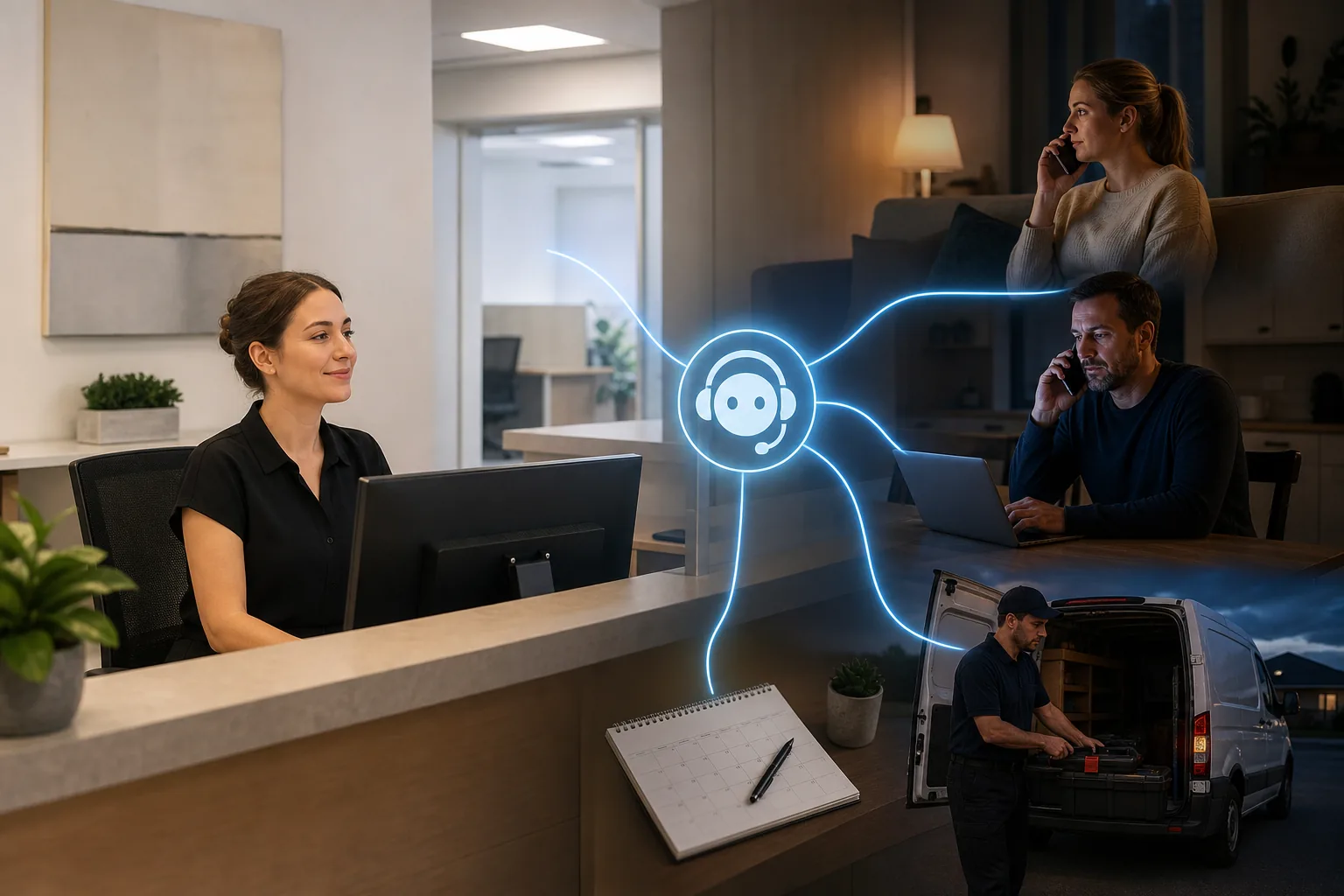
Freed Front Desk is an AI answering service for small business teams that need after-hours coverage and basic call routing.
Best fit: Medical and appointment-led businesses that need a call handled when staff are busy or offline.
Its listed use cases include after-hours answering, appointment scheduling, urgent call routing, and two-way SMS messaging. The service uses AI voice agents and can learn from a business website plus custom rules.
That setup can work well for a clinic that needs to separate routine booking from urgent requests. It could also help a service company route an emergency inquiry to the right person instead of sending every caller to the same inbox.
The key question is what happens after the call. Ask whether a booking lands directly in the calendar, whether an urgent route reaches a person, and whether the SMS thread stays tied to the original caller. A call flow that only records information may still leave the owner with the same follow-up burden.
Healthcare buyers should ask about privacy controls before sharing sensitive details. They should also check which scheduling or record systems connect to the service. The category research found that only 39% of reviewed services reported any third-party connections, while most gave no integration data.
Freed Front Desk makes sense when after-hours response is the main problem. It may be less suitable when you need a broader sales or admin system that runs beyond the phone.
For a wider look at call intake, calendars, integrations, and ROI, our AI Phone Answering Service Options for SMBs article can help you frame the questions before a demo.
Test one narrow route first. For example, send only after-hours booking calls through the system for two weeks. Review missed intents, wrong transfers, and the time your team still spends cleaning up messages.
3. EverHelp AI Assistant, 24/7 routine inquiries and appointment booking
EverHelp AI Assistant focuses on 24/7 coverage, routine customer questions, appointment scheduling, and call analytics.

Best fit: Small businesses with repeat questions and a clear booking process.
Routine questions are where an AI answering service can earn its keep. Think hours, service areas, appointment types, basic preparation steps, or the status of a standard request. If the answer lives on your website or in a short script, the assistant may handle it without pulling someone away from paid work.
Custom greetings and scripts let a business shape the first interaction. That sounds small, but tone and wording matter when callers are already frustrated. A heating customer calling during a cold night needs a different path from someone asking about a routine maintenance visit.
Appointment booking is the harder test. The assistant must know what counts as an open slot, which job types need more time, and when a human must review the request. A booking that lands in the wrong calendar creates more work instead of less.
Call analytics can help an owner see where the system breaks. Look for missed questions, transfer attempts, abandoned calls, and bookings that need correction. Do not judge the service by its greeting alone.
Pricing research in this category also points to a risk. Some services charge by minutes, calls, or monthly packages. A low entry rate can become hard to predict when call length changes or seasonal demand rises. Ask how billing increments work and what happens when volume exceeds the included amount.
Only three services mentioned a trial, and each cited a 14-day period. That makes a small pilot more useful than a long sales call. Use real calls with permission, not a rehearsed demo.
EverHelp AI Assistant is worth considering when your call flow is narrow and repeatable. It deserves more testing if your business has complex qualification rules, sensitive intake, or several calendars.
One useful follow-up is to track whether callers complete a booking during the first conversation. If staff still need to call most people back, the service may be answering calls without solving the real capacity problem.
4. Smith.ai, AI screening with live-agent escalation
Smith.ai combines AI screening with live-agent escalation for businesses that want an option beyond a fully automated call.
Best fit: Teams where a missed nuance can cost a valuable lead or create a service risk.
The listed use cases include lead screening, appointment scheduling, directions, after-hours coverage, and overflow answering. Its model lets AI handle routine intake while a live agent steps in when the conversation needs human attention.
That hybrid design can help a law firm, medical office, or service business with mixed call types. A caller asking for office hours may follow a simple route. A caller with a detailed case question or an upset complaint may need a person.
Smith.ai’s own description of its overflow service includes AI-first call handling with human support. It also describes live-agent coverage for businesses that want people answering calls instead of AI alone. Those are vendor claims, so buyers should test the actual handoff and ask what context the agent receives.
Human escalation changes the cost structure. It may be worth paying for when one poor intake call can lose a job. But it may not make sense for a business whose calls are mostly short, predictable questions.
Ask five questions before signing:
- What causes the handoff?
- Does the live agent see the caller’s prior answers?
- Can the agent book in the correct calendar?
- How are notes and dispositions sent to your team?
- What happens during a call surge?
The broader research found that only 22% of services explicitly listed limitations. That silence can make a hybrid model look simpler than it is. Put edge cases into the test plan, especially angry callers, unclear names, urgent requests, and callers who change topics midstream.
Smith.ai is a reasonable option when human backup is part of the requirement. If your goal is a full operating system for calls plus follow-up work, compare it with a done-for-you service such as Huge AI.
For regulated businesses, do not rely on a general compliance badge alone. Confirm how recordings, notes, access rights, and escalation records fit your own E&O and privacy controls.
5. Dialzara, Routing, message taking, and lead qualification
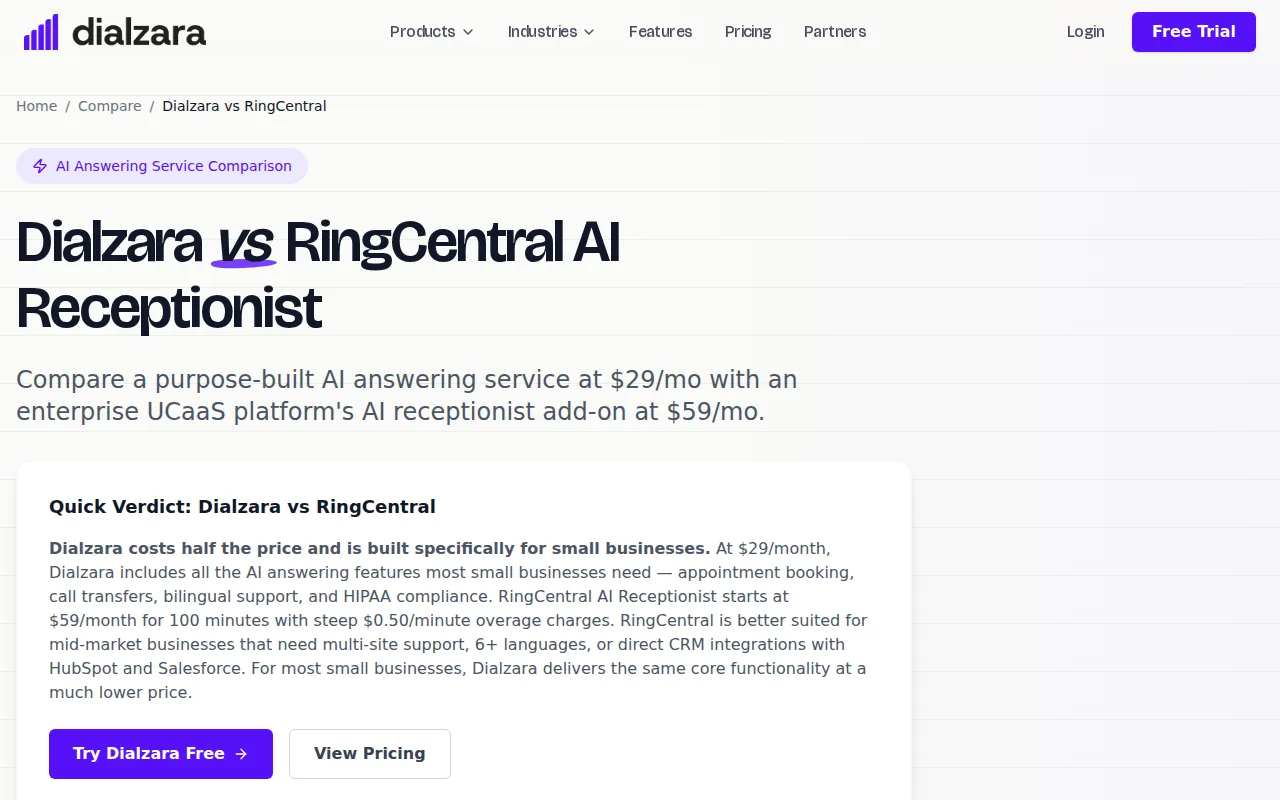
Dialzara handles inbound routing, message taking, appointment scheduling, and lead qualification.
Best fit: Small service businesses that want a focused AI receptionist for lead capture and basic routing.
Its industry material describes workflows for solar businesses, including qualification questions, appointment booking, priority flags, and routing to the right person.
That makes the qualification step the main point to test. A solar company may need to ask about property ownership, roof age, or the caller’s project. A home service company may need the address, job type, and urgency. The value comes from sending a useful lead record to the right person, not from collecting a name and email alone.
Dialzara also lists message taking and call routing. Those are useful when the owner is on a job site or the office is closed. But a route is only as good as the contact rules behind it. Set clear rules for urgent calls, repeat customers, existing jobs, and requests that should never go to an automated path.
Its solar page describes shared knowledge across phone, two-way SMS, and a website chat widget. Buyers should verify which channels are included in the plan they need and whether information stays in one record.
Lead capture also needs a review loop. Someone should inspect a sample of call summaries each week. Check whether the system recorded the right service, location, urgency, and next action. Fix the script when the same error appears twice.
A useful companion to phone intake is a structured way to share contact details and route bookings. A digital card service such as a digital card service fits that next step when an owner wants contacts to move into a record instead of staying in scattered messages.
Dialzara may suit a focused inbound workflow. It needs more proof before a business uses it for complex sales logic, high-stakes advice, or a process with many exceptions.
AI Answering Service Comparison for Small Business
The right choice depends on what you want removed from your week. An answering service can take calls, but it may not complete the work attached to those calls.
| Option | Best operational fit | What to test | Main watchout |
|---|---|---|---|
| Huge AI | Done-for-you call handling plus follow-up systems | Hours saved, lead response, calendar actions, and handoffs | Define the first workflow clearly before expanding scope |
| Freed Front Desk | After-hours coverage and urgent routing | Booking flow, SMS continuity, and escalation rules | Check system connections and privacy needs |
| EverHelp AI Assistant | Routine questions and appointment booking | Accuracy on repeat questions and calendar placement | Complex logic may need a different setup |
| Smith.ai | AI screening with human backup | Handoff speed, context transfer, and intake quality | Live support changes the cost model |
| Dialzara | Routing, lead qualification, and message taking | Required questions, lead records, and routing accuracy | Confirm integrations and usage limits |
Before you buy, write down the exact job the system must finish. “Answer calls” is too broad. “Capture every after-hours HVAC lead, ask for the address, mark emergencies, and send a complete summary” is testable.
Then ask for evidence. Measure your own baseline: missed calls, average call length, booking rate, staff follow-up time, and errors.
If you run an insurance agency, include compliance review in the test. Keep advice, coverage decisions, and sensitive changes with a qualified person unless your controls clearly permit automation. For other service businesses, start with a low-risk path and expand only after the records look right.
Huge AI’s free AI Growth Roadmap is a sensible starting point when you want help choosing the workflow itself. The 45-minute slot is designed to show which fixes could save 5+ hours each week before you commit to a build.
FAQ
What is an AI answering service for small business?
An AI answering service handles business calls with a voice assistant instead of sending every caller to voicemail. Depending on the service, it may answer routine questions, route calls, capture leads, or book appointments. The key difference is whether it completes a useful business action or only records a message.
Can an AI answering service book appointments?
Yes, some AI answering services can book appointments, but you should confirm how they check availability and which calendar they use. Test rescheduling, double-booking rules, appointment length, and confirmation messages. A booking that lands in the wrong calendar creates more admin work for a small team.
Is AI phone answering safe for an insurance agency?
AI phone answering can support an insurance agency, but it should not make coverage judgments without clear controls and human review. Keep sensitive intake, advice, and policy changes inside approved workflows. Review recording access, retention, vendor terms, and E&O exposure before placing client calls into an automated system.
What should a small business ask before choosing an AI receptionist?
Ask what the system does after it answers. Confirm the handoff rules, calendar access, CRM connection, pricing unit, escalation path, and reporting. Also ask for a pilot using your actual call types. Marketing pages often list many use cases, while the deeper automation may cover only a few.
How can I estimate the ROI of an AI answering service?
Start with your current missed calls, staff follow-up time, average booking value, and call error rate. Then test one workflow and compare the same measures after launch. Huge AI’s free AI Growth Roadmap can map 3 to 7 possible fixes and estimate the dollar and hour value before you spend on implementation.
Should I choose AI-only or AI with live-agent backup?
Choose AI-only for clear, repeatable calls with low risk. Choose live-agent backup when callers need judgment, detailed intake, or careful handling. A hybrid service costs more than a simple automated route, but that trade may make sense when one missed or mishandled call carries a high value.
Conclusion
For owners who want call handling tied to follow-up and broader operations, Huge AI is the strongest starting point because we build and run the workflow instead of handing you another tool. Grab a free 45-minute AI Growth Roadmap, identify one process that could save 5+ hours a week, and test that process before expanding.
For a related view of the systems that sit beyond the phone, our AI Automation Services for Small Businesses resource can help you spot the next workflow to hand off.
Want an AI employee that answers every lead instantly?
That's what we build at Huge AI. One flat plan, no fine print.
See pricing →